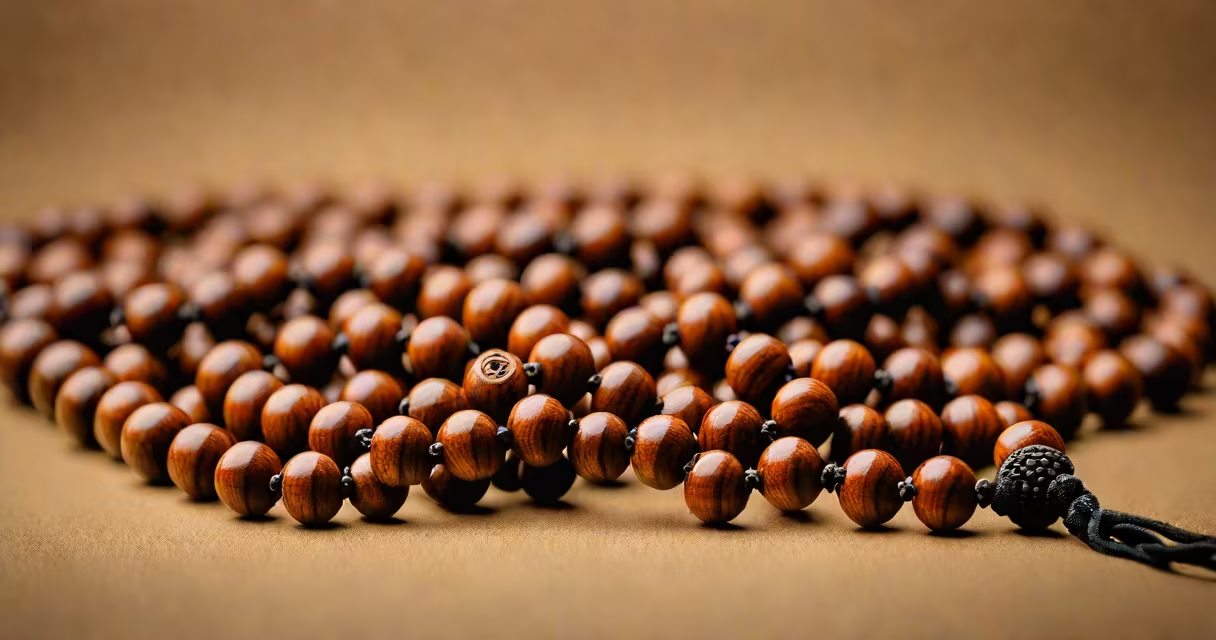
A 108 beads mala for meditation is a string of 108 beads used in Hindu and Buddhist traditions to count mantras, prayers, or breaths during meditation. These beads serve as a tactile aid to keep track of repetitions and maintain focus.
The mala typically consists of 108 beads, though some may have additional marker beads. The primary bead, often larger or distinct, is called the "guru bead." Meditators move their fingers along the beads, reciting a mantra or taking a breath with each bead. Upon reaching the guru bead, they either stop or turn the mala around without crossing over the guru bead, which symbolizes respect for the teacher.
Malas come in various materials, each believed to carry different energetic properties. Common types include:
| Material | Properties |
|---|---|
| Wood (e.g., sandalwood, rudraksha) | Grounding, calming, and purifying |
| Seeds (e.g., tulsi, lotus) | Spiritual protection and healing |
| Gemstones (e.g., malachite mala beads, lapis lazuli) | Improve specific intentions (e.g., malachite for transformation) |
| Crystals (e.g., quartz, amethyst) | Amplify energy and clarity |
To use a mala, hold it in your right hand, letting the beads rest between your middle finger and thumb. Start at the guru bead, then move to the next bead with each repetition. As you reach the end, avoid crossing the guru bead; instead, flip the mala and continue in the opposite direction. This practice ensures respect for the teacher and maintains the mala's integrity.
I first used a mala during a guided meditation session. The tactile sensation of moving each bead helped me stay present and focused, even when my mind wandered. By the time I reached the guru bead, I felt a sense of completion and accomplishment in my practice.
The number 108 holds significance in Hinduism, Buddhism, and yoga. Some theories suggest it represents the number of ups and downs in life, while others link it to astronomical ratios. According to the Yoga Vashishtha, there are 108 marma points (pressure points) in the body, and chanting 108 times aligns with these energy centers.
According to Dr. Stephen Phillips, a professor of Sanskrit and Indian Studies at Harvard University, "The number 108 appears frequently in Vedic literature, symbolizing the universe and the totality of existence." This makes the mala a useful tool for connecting with the cosmos during meditation.