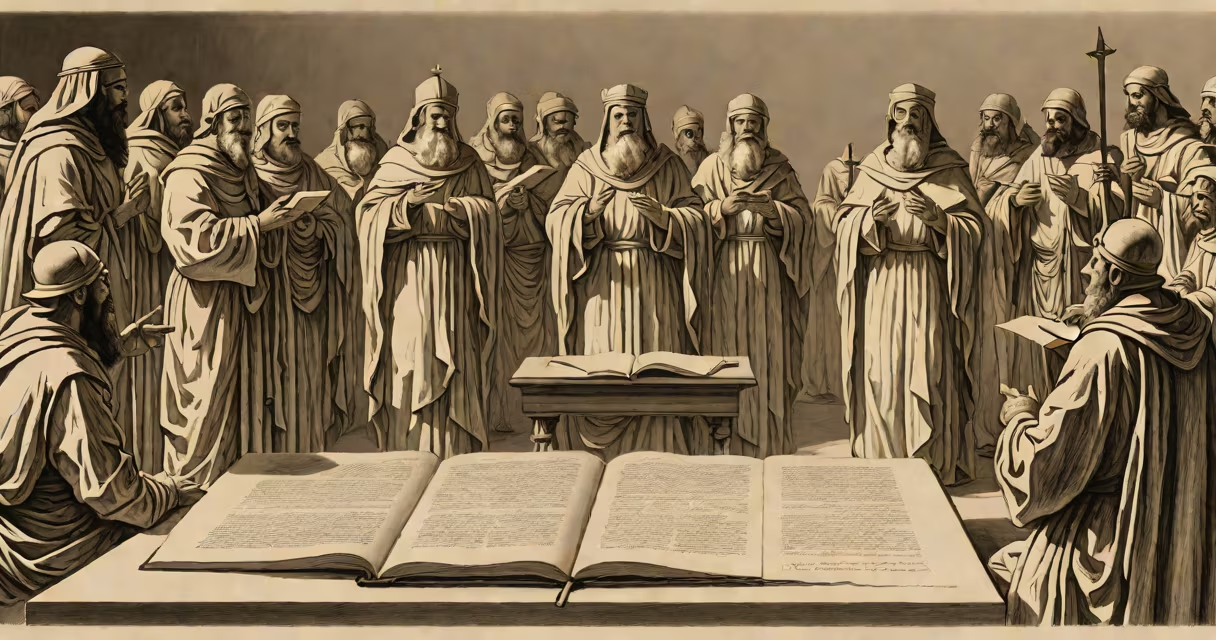
The Arian heresy was a 4th-century Christian movement that denied Jesus' co-eternality with God, teaching instead that Christ was created by God and therefore subordinate. This theological dispute triggered centuries of religious conflict and led to the formulation of the Nicene Creed.
Arianism originated with Arius, a Libyan presbyter in Alexandria, who argued that the Son (Jesus) was not co-eternal with the Father (God). According to Arius, the Son was created by God and therefore had a beginning, making Him inferior to God. This contradicted the prevailing belief that Jesus was of the same substance as God.
The debate centered on the nature of Christ and His relationship to God. Arius' teachings gained significant support, particularly among some bishops and secular authorities. The controversy became so intense that it required intervention from Emperor Constantine, who convened the Council of Nicaea in 325 AD to resolve the issue.
| Type | Belief | Key Figures |
|---|---|---|
| Homoousian | Believed in the consubstantiality of the Father and the Son | Alexander of Alexandria, Athanasius |
| Homoiousian | Believed the Son was similar in substance to the Father | Eusebius of Caesarea, Acacius of Caesarea |
| Anomoean | Believed the Son was unlike the Father in substance | Aetius, Eunomius |
The Arian heresy spread throughout the Roman Empire, particularly in the Eastern provinces. It gained traction among those who sought to reconcile Christian beliefs with Greek philosophy, which emphasized the supremacy of the uncreated God over any created being. The controversy was not merely theological but also political, as different factions sought to align themselves with useful figures within the empire.
The Arian heresy is commonly confused with other early Christian heresies, such as Docetism and Adoptionism. However, Arianism specifically focused on the nature of Christ's relationship to God, whereas Docetism denied Christ's physical existence, and Adoptionism taught that Jesus was a man adopted by God.
At the Council of Nicaea, the debate between Arius and his opponents reached its peak. The council affirmed the belief that the Son was "of one substance with the Father" (homoousios), directly opposing Arius' teachings. This led to the formulation of the Nicene Creed, which remains a foundational statement of Christian faith. Despite the council's decision, Arianism persisted for centuries, particularly among the Goths and Vandals, until it was gradually suppressed by the Catholic Church.
I once visited the ancient city of Nicaea (modern-day İznik, Turkey), where the council was held. Standing in the ruins, I could imagine the intensity of the debates that took place there, shaping the course of Christian theology for centuries to come.
The Arian heresy definition encompasses a significant chapter in the history of Christianity. Its resolution at the Council of Nicaea and the subsequent formulation of the Nicene Creed laid the groundwork for orthodox Christian belief. Understanding the Arian heresy provides insight into the complex interplay of theology, politics, and power that characterized the early Christian era.