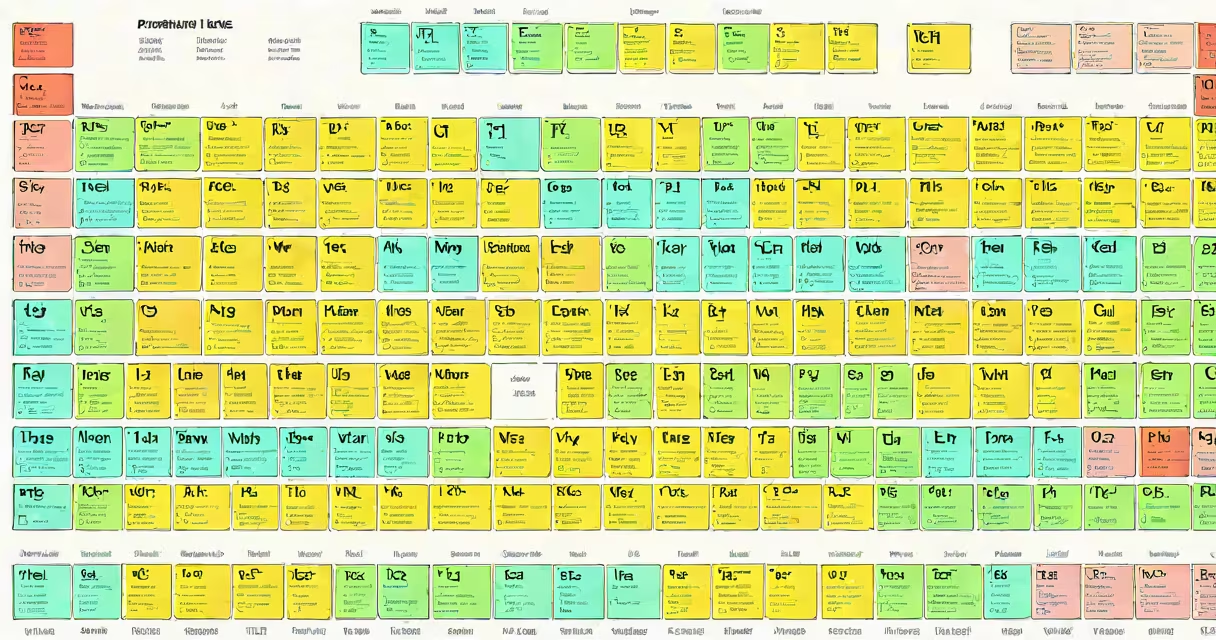
The arrangement of periodic table organizes chemical elements by increasing atomic number and repeating properties, creating a grid with horizontal rows (periods) and vertical columns (groups). This structure reveals patterns that predict element behavior.
Russian chemist Dmitri Mendeleev created the first version in 1869, leaving gaps for undiscovered elements. Today's table includes 118 confirmed elements, arranged in 18 vertical columns (groups) and 7 horizontal rows (periods). A separate row contains 16 rare earth metals, often shown separately due to their similar properties.
Elements are ordered by atomic number, which equals the number of protons in their nuclei. As atomic numbers increase, electron configurations repeat in predictable patterns, creating the table's periodic structure. Elements in the same group share similar properties because they have the same number of electrons in their outer shell (valence electrons).
For example, all Group 1 elements (alkali metals) have one valence electron, making them highly reactive. Fluorine (F), chlorine (Cl), and other Group 17 elements (halogens) each have seven valence electrons, causing them to readily gain one electron during chemical reactions.
| Group | Properties | Examples |
|---|---|---|
| Alkali Metals (Group 1) | Highly reactive, soft, low-density metals | Lithium (Li), Sodium (Na), Potassium (K) |
| Alkaline Earth Metals (Group 2) | Reactive but less so than Group 1, harder than alkali metals | Magnesium (Mg), Calcium (Ca) |
| Transition Metals (Groups 3-12) | Hard, high-melting-point metals with variable valence electrons | Iron (Fe), Copper (Cu), Gold (Au) |
| Post-Transition Metals (Groups 13-16) | Metalloids and poor metals with mixed properties | Aluminum (Al), Tin (Sn), Lead (Pb) |
| Halogens (Group 17) | Highly reactive nonmetals that form salts with metals | Fluorine (F), Chlorine (Cl) |
| Noble Gases (Group 18) | Inert gases with full valence shells | Helium (He), Neon (Ne), Argon (Ar) |
| Lanthanides and Actinides | Rare earth metals with similar properties | Cerium (Ce), Uranium (U) |
The seven horizontal rows are called periods. Elements in the same period have the same number of electron shells. The table is also divided into blocks based on the subshell in which the last electron is placed: s-block, p-block, d-block, and f-block.
For example, hydrogen (H) is in the first period and s-block because its single electron occupies the 1s subshell. Oxygen (O) is in the second period and p-block because its six electrons fill the 1s and 2s subshells, with two electrons in the 2p subshell.
Many people assume the arrangement of periodic table is purely alphabetical or based on atomic weight. While Mendeleev originally ordered elements by atomic weight, the modern table uses atomic number. This sequence better reflects element properties and eliminates inconsistencies caused by exceptions in atomic weight ordering.
Another misconception is that all elements in the same group have identical properties. While they share similarities, each element has unique characteristics. For instance, while all halogens are reactive, fluorine is more reactive than chlorine, which is more reactive than bromine.
I once observed a chemistry student confused about why noble gases were placed in Group 18. They assumed the group number corresponded to the number of valence electrons. Explaining that Group 18 elements have full valence shells (eight valence electrons, or two for helium) helped clarify the pattern.
The arrangement of periodic table allows scientists to predict unknown properties and discover new elements. For example, Mendeleev predicted the existence and properties of germanium (Ge) and gallium (Ga) based on gaps in his table. Both elements were later discovered and matched his predictions.
Today, researchers use the table to synthesize new elements and understand their behavior. The arrangement also helps educators teach chemistry concepts and students memorize element properties efficiently.
To learn more about the periodic table and its history, explore its evolution from Mendeleev's first draft to the modern version we use today. Understanding the periodic table is essential for grasping fundamental chemistry concepts. For specific elements like D on the periodic table, the arrangement provides context for their properties and uses.