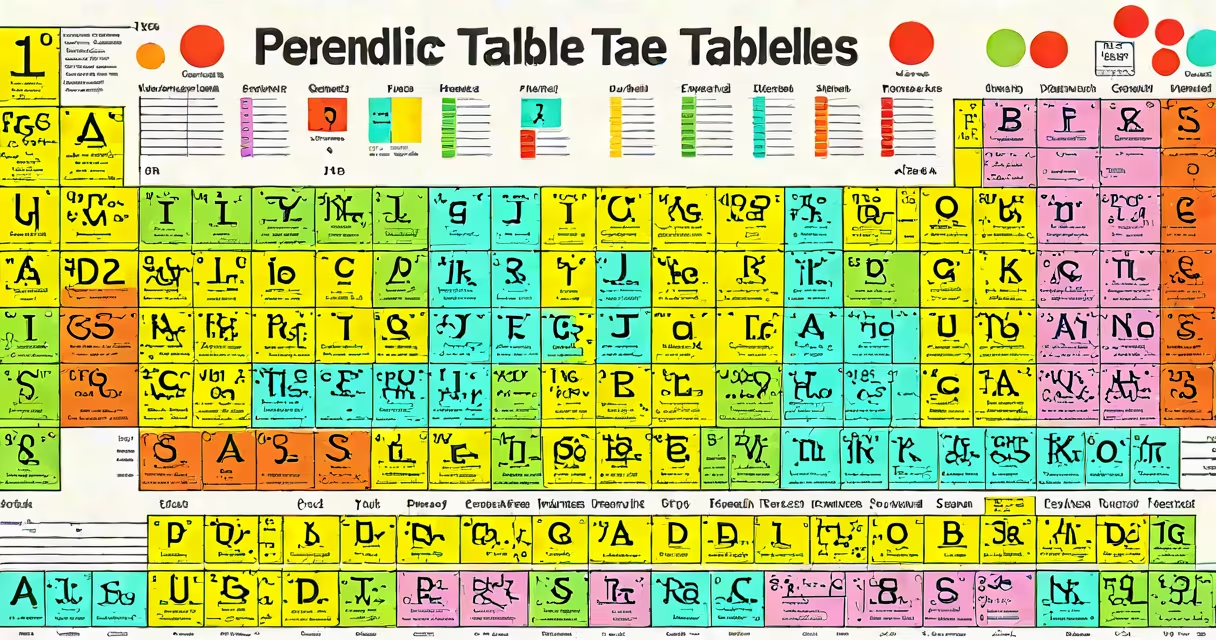
The periodic table is a systematic arrangement of chemical elements ordered by increasing atomic number, showcasing recurring trends in properties. This chart organizes all known elements into rows (periods) and columns (groups), revealing patterns that predict behavior.
Elements are placed based on their atomic number (protons in the nucleus) and electron configurations. The table's structure creates:
For example, oxygen (O) and sulfur (S) are in Group 16 because they both have six valence electrons, making them reactive with metals.
| Type | Examples | Key Characteristics |
|---|---|---|
| Metals | Iron (Fe), Copper (Cu) | Malleable, conductive, lose electrons easily |
| Nonmetals | Carbon (C), Oxygen (O) | Poor conductors, gain electrons easily |
| Metalloids | Silicon (Si), Boron (B) | Properties between metals and nonmetals |
| Halogens | Fluorine (F), Chlorine (Cl) | Highly reactive, form salts with metals |
| Noble Gases | Helium (He), Neon (Ne) | Inert, rarely react with other elements |
Chemists use the periodic table to predict how elements will behave in reactions. For instance, knowing that lithium (Li) is in Group 1 tells us it will react vigorously with water, similar to other alkali metals.
The table also helps identify unknown substances. When analyzing a new compound, scientists compare its properties to known elements in specific groups.
Many assume heavier elements are always rarer. While true for most, exceptions exist. Argon (Ar), a noble gas, makes up 0.93% of Earth's atmosphere despite being heavier than lighter elements like neon (Ne).
Another myth is that all elements exist naturally. In reality, elements with atomic numbers higher than 92 (uranium) are synthetic, created in laboratories.
When building a battery, engineers might combine lithium (Li) from Group 1 with cobalt (Co) from Group 9. Lithium's reactivity and cobalt's stability create a useful energy source. Understanding the periodic table's layout helps select compatible elements for technological advancements.