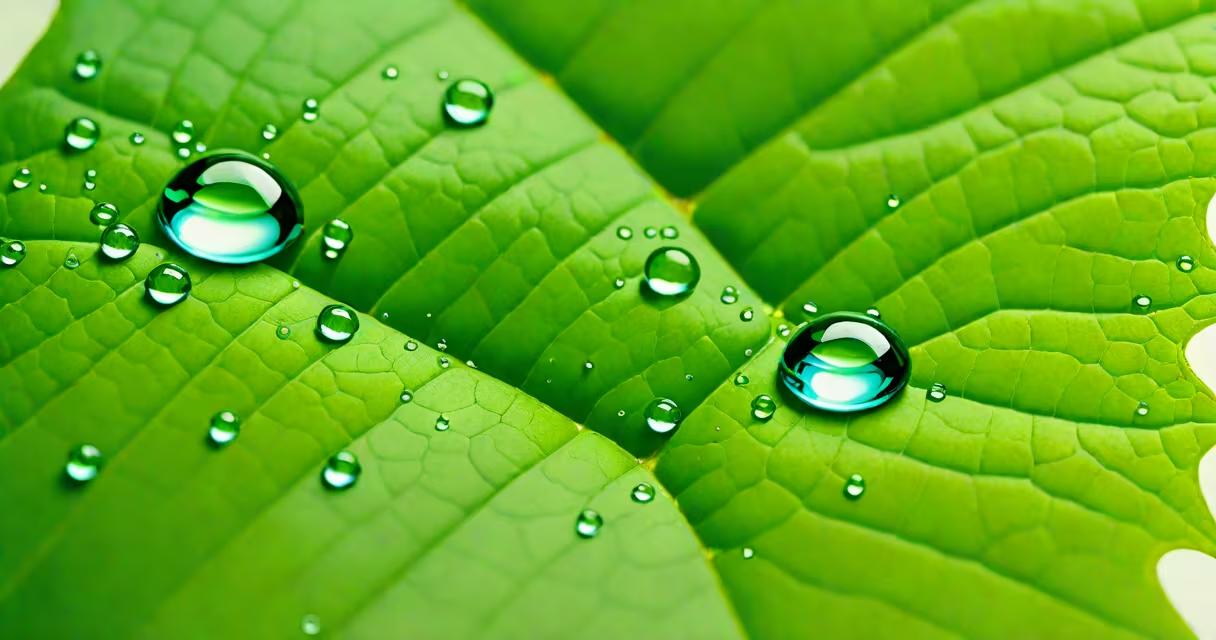
Surface tension is the property of a liquid's surface that allows it to resist external forces, acting like an invisible elastic sheet. This occurs because water molecules at the surface form stronger bonds with each other than with air.
Water molecules bond through cohesive forces created by hydrogen bonding. Each molecule has two hydrogen atoms and one oxygen atom, forming partial positive and negative charges. These opposite charges attract neighboring molecules, creating a network of bonds.
At the surface, molecules lack neighbors above them, so they bond more strongly with adjacent surface molecules. This creates a tighter, higher-energy layer that behaves like a stretched membrane. The energy required to break these bonds gives water its characteristic surface tension of about 72 dynes/cm at room temperature.
| Effect | Description | Example |
|---|---|---|
| Droplet formation | Liquid minimizes surface area to reduce energy | Raindrops forming spheres |
| Capillary action | Liquid climbs narrow spaces against gravity | Water rising in a thin glass tube |
| Floating objects | Surface acts like a membrane supporting light loads | Water striders walking on ponds |
Surface tension enables essential natural processes. Plants rely on it to transport water through capillary action. Insects exploit it to walk on water, and some animals use it to create floating nests. Even cleaning products like detergents work by breaking surface tension to spread more effectively.
Surface tension also explains why some liquids mix while others don't. Alcohol, for example, has weaker hydrogen bonds than water, so it mixes easily. Oils, lacking hydrogen bonds entirely, float on water due to their lower surface tension.
Many assume surface tension only affects water, but it applies to all liquids. Alcohol, for instance, has surface tension too-just weaker. Soap solutions reduce surface tension dramatically, which is why they help remove grease from surfaces.
One surprising fact: surface tension allows some small creatures to survive underwater without breathing air. The diving bell spider, for example, creates an air bubble using surface tension to breathe underwater.
Last summer, I noticed water beads forming perfect spheres on a freshly waxed car. When I added dish soap to a bucket of water, the beads instantly flattened. This demonstrated how soap breaks surface tension, making water wet surfaces more effectively.