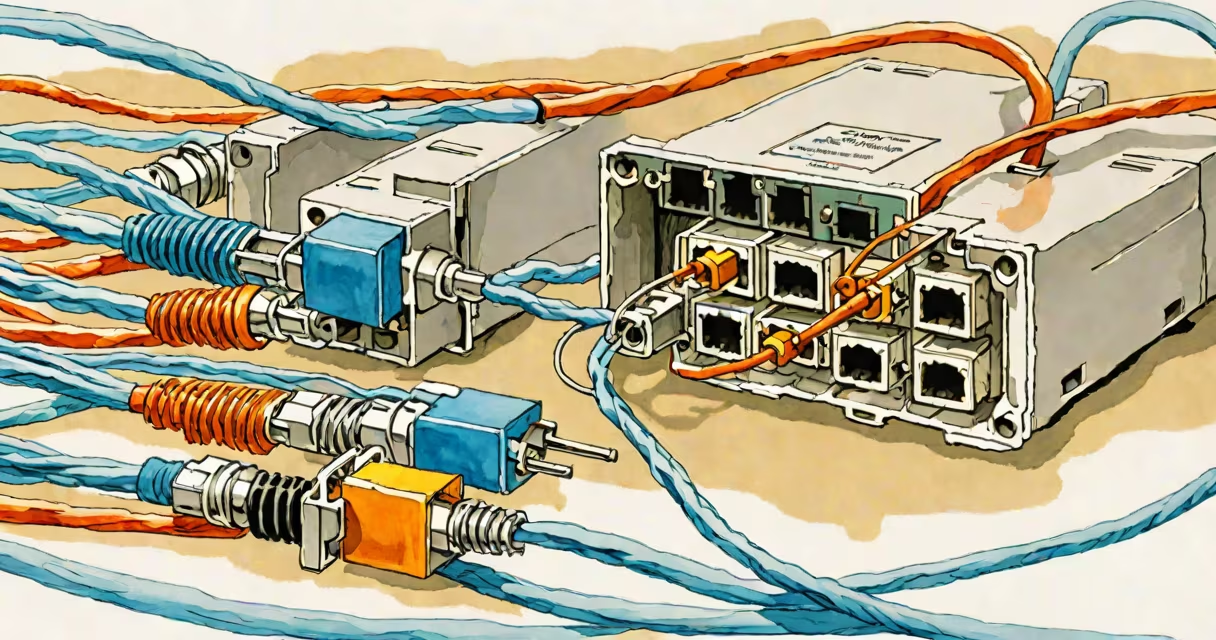
A fiber cable to ethernet converter is a device that translates signals between fiber optic cables and copper-based ethernet cables, allowing data to flow between these two network types. These converters enable high-speed connections in environments where fiber optic infrastructure meets traditional ethernet networks.
Fiber optic cables transmit data using light pulses, while ethernet cables use electrical signals. A fiber-to-ethernet converter contains optical-to-electrical (O/E) and electrical-to-optical (E/O) components that convert these signals bidirectionally. When a light pulse arrives via fiber, the converter transforms it into an electrical signal compatible with ethernet cables, and vice versa.
Most converters support multiple conversion modes, including full-duplex (simultaneous two-way communication) and half-duplex (one-way communication at a time). They often include diagnostic features like LED indicators to monitor signal strength and connection status.
| Type | Key Features | Typical Applications |
|---|---|---|
| Single-mode to multi-mode | Converts between different fiber types | Campus networks, data centers |
| Copper to fiber | Extends ethernet over longer distances | Office networks, industrial settings |
| PoE-enabled | Supports Power over Ethernet | Security cameras, VoIP phones |
These converters are essential in hybrid networks where fiber optic backbones meet copper-based local area networks. For example, a university might use fiber optic cables to connect buildings but rely on ethernet within those buildings. The converter bridges this gap without requiring a complete infrastructure overhaul.
Businesses often deploy these devices to extend network reach beyond the typical 100-meter limit of ethernet cables. A retail chain might use fiber between stores but ethernet within each store, with converters at each location.
Many assume these converters introduce latency, but modern devices add less than 1 microsecond of delay - negligible for most applications. Another myth is that they reduce bandwidth, but quality converters maintain the original speed of both fiber and ethernet connections.
I once set up a network for a small office that needed to connect to a fiber internet provider but had existing ethernet switches. A single fiber-to-ethernet converter solved the problem without requiring new switches or extensive rewiring.
According to the Telecommunications Industry Association, fiber-to-ethernet converters are becoming increasingly common as businesses upgrade their internet connections while maintaining existing copper-based internal networks.