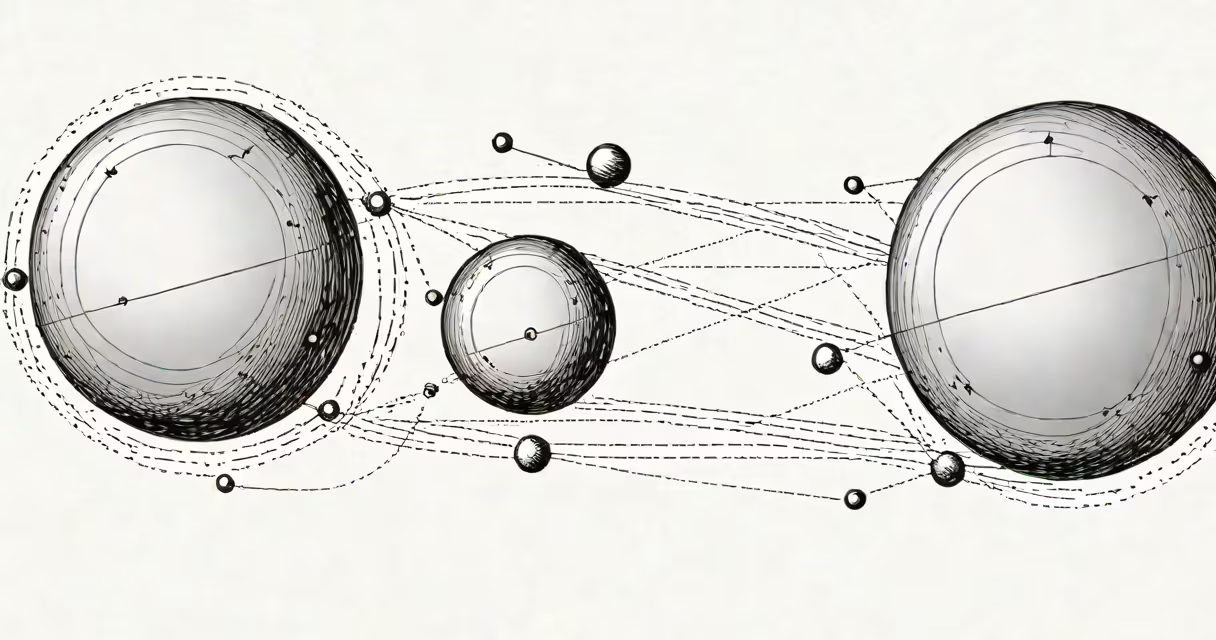
The gravitational force between masses problem describes how two objects attract each other based on their mass and the distance between them. This fundamental concept in physics was first explained by Isaac Newton's law of universal gravitation.
Every mass exerts a gravitational pull on every other mass. The force is always attractive and acts along the line connecting their centers. The strength of this force depends on two factors: the product of the masses and the inverse square of the distance between them.
Mathematically, the gravitational force (F) between two masses (m₁ and m₂) separated by distance (r) is calculated using the formula:
F = G * (m₁ * m₂) / r²
Where G is the gravitational constant (6.674 × 10⁻¹¹ N·m²/kg²).
Gravitational force problems typically fall into these categories:
| Type | Description | Example |
|---|---|---|
| Force Calculation | Determine the gravitational force between two objects | Find the force between Earth and a 1 kg mass at the surface |
| Acceleration | Calculate the acceleration caused by gravity | Determine g at different altitudes above Earth |
| Orbital Mechanics | Analyze the motion of orbiting objects | Calculate the orbital velocity of satellites |
Many people confuse gravitational force with weight. While weight is a result of gravitational force, it's specifically the force exerted by a mass in a gravitational field (usually Earth's). Weight varies with location, while mass remains constant.
Another misconception is that gravitational force operates only between very large masses. In reality, every object with mass attracts every other object, no matter how small. However, the force between everyday objects is extremely tiny due to their small masses and relatively large distances between them.
Understanding gravitational force is important in many fields. In space exploration, scientists use these principles to calculate orbits and trajectories. Engineers apply gravitational calculations when designing structures that must withstand Earth's gravity.
One practical application is calculating the gravitational force between two planets. For example, the force between Earth (mass ≈ 5.97 × 10²⁴ kg) and Mars (mass ≈ 6.39 × 10²³ kg) at their closest approach (about 5.46 × 10⁷ km) is approximately 1.7 × 10¹⁵ N.
I once used these calculations when building a model of the solar system. By applying Newton's law of universal gravitation, I could accurately position each planet relative to the Sun, demonstrating the balance between gravitational forces and orbital velocities that maintains celestial stability.
While gravitational force is always attractive, other fundamental forces in physics can be either attractive or repulsive. Electromagnetic force, for example, can push objects apart or pull them together, depending on the charges involved.
Another distinction is that gravitational force acts on all types of mass (both gravitational and inertial), whereas other forces may interact differently with different types of mass or energy.