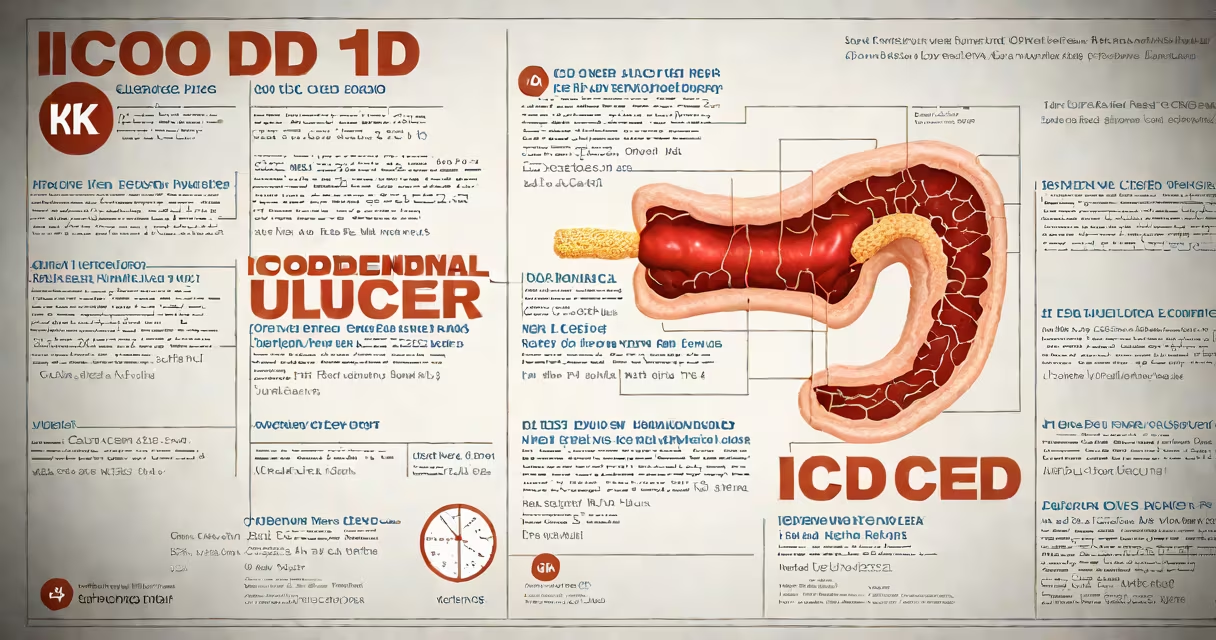
The ICD 10 code for duodenal ulcer is K26, which categorizes this specific type of peptic ulcer disease for medical billing and record-keeping. This code is part of the International Classification of Diseases, 10th Revision, a standardized system used worldwide.
The ICD 10 code system assigns unique alphanumeric codes to diseases, symptoms, and procedures. For duodenal ulcers, K26 is the primary code. Additional codes may be used to specify complications, such as hemorrhage (K26.0) or perforation (K26.2). These codes ensure accurate documentation and reimbursement.
Duodenal ulcers are classified under several ICD 10 codes based on their presentation:
| Code | Description |
|---|---|
| K26 | Duodenal ulcer, unspecified |
| K26.0 | Duodenal ulcer with hemorrhage |
| K26.2 | Duodenal ulcer with perforation |
| K26.4 | Duodenal ulcer with both hemorrhage and perforation |
| K26.6 | Chronic or recurrent duodenal ulcer without hemorrhage or perforation |
These codes help clinicians differentiate between various presentations of duodenal ulcers, ensuring precise treatment and billing.
Accurate coding is critical for patient care and healthcare administration. The ICD 10 code K26 helps duodenal ulcers are properly documented, facilitating effective communication between healthcare providers. It also supports insurance claims and public health tracking.
For example, a patient presenting with a bleeding duodenal ulcer would be coded as K26.0. This code alerts healthcare providers to the severity of the condition and guides appropriate treatment, such as endoscopic intervention or medication adjustments.
Another common mistake is assuming that all duodenal ulcers are coded the same way. As shown in the table above, different codes are used based on the presence of complications like hemorrhage or perforation. Accurate coding helps the specific condition is properly addressed.
As a healthcare professional, I've seen firsthand how precise coding impacts patient outcomes. During my time working in a gastroenterology clinic, I noticed that patients with duodenal ulcers often required multiple follow-up visits. Using the correct ICD 10 code, such as K26.6 for chronic ulcers, helped simplify their care and ensured that insurance companies covered necessary treatments.
Accurate coding also played a important role in tracking the effectiveness of treatments. For instance, if a patient's ulcer healed after medication, their subsequent visit would be coded differently, reflecting the resolution of the condition.
The ICD 10 code for duodenal ulcer, K26, is essential for accurate medical documentation and billing. Understanding the different subtypes of this code helps healthcare providers deliver the best possible care. a professional looking to improve coding practices, knowing these details can make a significant difference.