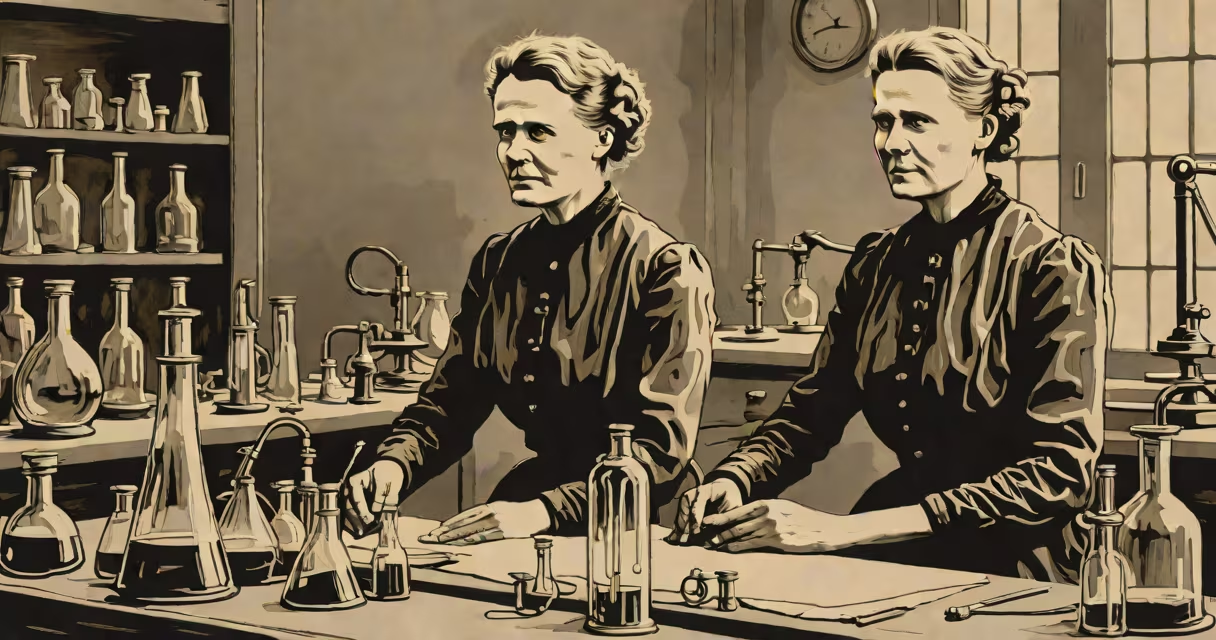
Marie Curie Achi refers to the scientific achievements of Marie Curie, particularly her pioneering work in radioactivity that led to the discovery of two new elements, polonium and radium. Her research laid the foundations for nuclear physics and cancer therapy.
Marie Curie's work transformed our understanding of atomic structure. By isolating radioactive isotopes, she demonstrated their potential for both scientific research and medical applications. Her methodical approach involved processing tons of pitchblende ore to extract trace amounts of radium, a process that took years of laborious work.
Curie identified polonium in 1898, naming it after her native Poland. A year later, she and her husband Pierre Curie discovered radium, which glows faintly in the dark due to intense radioactivity. These discoveries earned her two Nobel Prizes-the only person to win in multiple sciences.
| Element | Discovery Year | Key Property |
|---|---|---|
| Polonium | 1898 | Extremely radioactive, short half-life |
| Radium | 1899 | Glows in the dark, used in early medical treatments |
Many believe Curie invented X-rays, but that credit goes to Wilhelm Röntgen. Others assume her work was purely theoretical, though she spent years in grueling lab conditions refining radioactive materials. Her hands were severely damaged from prolonged radiation exposure, a risk she acknowledged but accepted for the sake of science.
Radium's intense radiation made it useful in early 20th-century medicine. Doctors embedded tiny radium needles into tumors, destroying cancer cells. Though unsafe by modern standards, this marked the birth of radiotherapy. Today, Curie's work inspires targeted radiation therapies that minimize harm to healthy tissue.
I visited the Curie Museum in Paris, where her original lab equipment is preserved. Seeing her notebooks-still radioactive today-drove home the physical toll of her discoveries. The museum's exhibits clarify how her research bridged physics and medicine, a legacy still evolving in cancer treatment.
Curie's discoveries remain important in nuclear energy and cancer research. Polonium-210, for instance, powers spacecraft batteries. Radium's medical applications evolved into safer isotopes like cobalt-60. Her work also pioneered techniques for isolating radioactive materials, essential for modern nuclear reactors and medical imaging.