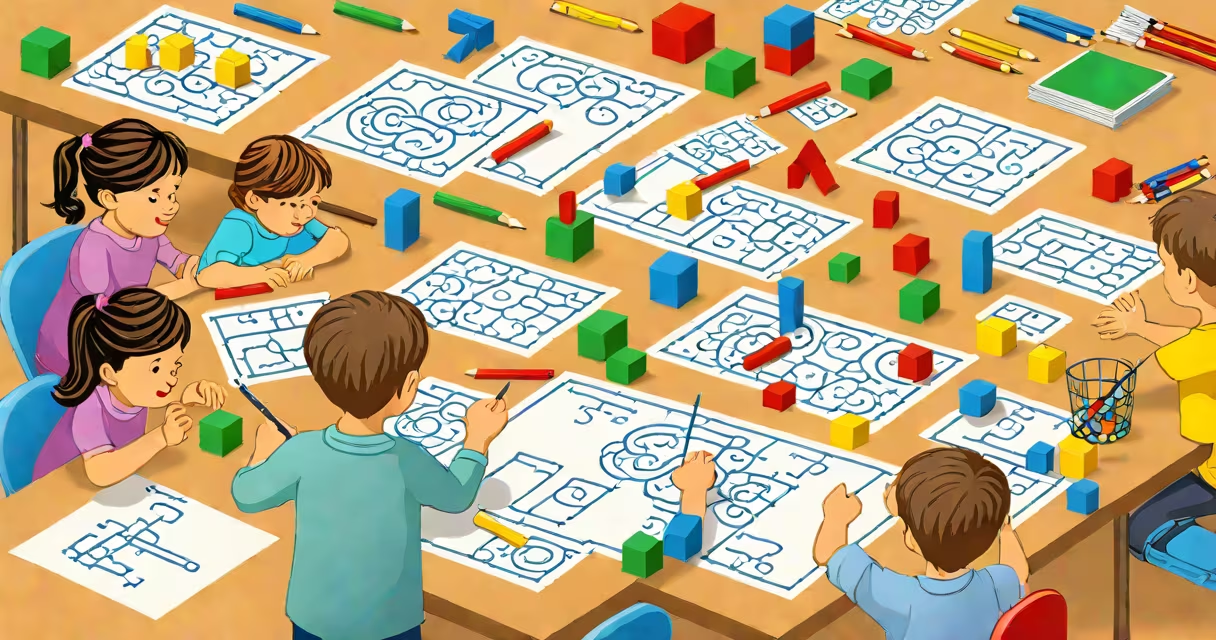
Math lessons for kindergarten introduce young children to basic numerical concepts through playful, hands-on activities designed for their developmental stage. These lessons typically focus on counting, shapes, simple addition and subtraction, and number recognition using physical objects, songs, and games.
Kindergarten math lessons emphasize experiential learning. Children use manipulatives like blocks, counters, or even snacks to visualize abstract concepts. For example, a teacher might ask students to count out five apples from a basket or arrange plastic shapes into patterns. This tactile approach helps children understand numbers and operations in a concrete way before moving to symbolic representation.
Most kindergarten math curricula cover five core areas:
Many programs follow the Common Core State Standards, which outline expectations for kindergarten math proficiency. According to the Common Core website, kindergarteners should be able to count to 100 by the end of the year and solve addition and subtraction problems within 5.
Research shows that young children learn mathematical concepts most effectively through play. A study published in the journal Developmental Psychology found that children who engage in math-related games demonstrate stronger number sense than those who receive traditional instruction. Kindergarten teachers often incorporate movement, music, and storytelling to maintain engagement while teaching mathematical concepts.
One effective activity involves using a number line to solve simple problems like 2 + 3. Children physically move counters along the line, developing both computational skills and spatial awareness. Teachers might also read books featuring numbers, such as Mouse Count by Ellen Stoll Walsh, which integrates math into a story format.
Many parents assume that kindergarten math focuses primarily on rote memorization of numbers. In reality, early math education emphasizes conceptual understanding over memorization. For example, rather than simply reciting numbers, children learn to associate quantities with numerals through activities like counting objects or matching numbers to groups of items.
Another misconception is that advanced topics like multiplication should wait until later grades. However, kindergarteners can begin developing foundational skills for multiplication through grouping activities. For instance, they might arrange four groups of three blocks each to understand the concept of repeated addition, which is a precursor to multiplication.
When I helped my nephew with his math homework, we turned it into a game. We used his toy cars to practice counting and sorting by color. He didn't realize he was learning - he just thought we were playing. That's the power of integrating math into play.