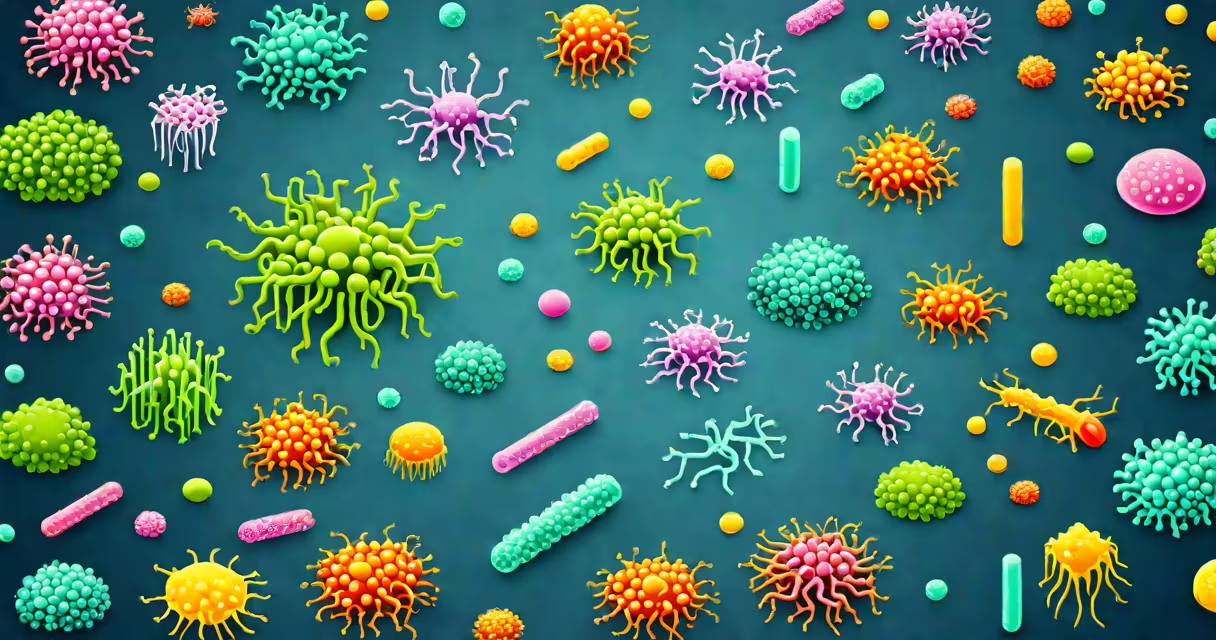
Microbes are microscopic organisms, including bacteria, viruses, archaea, and protists, that play important roles in ecosystems and human health.
These tiny life forms exist everywhere: in soil, water, air, and even inside other organisms. Microbes reproduce rapidly, often through binary fission or budding. Most are single-celled, though some form multicellular structures. They communicate using chemical signals and can form complex communities called biofilms.
Bacteria are the most abundant microbes, found in nearly every environment. They have a simple cell structure without a nucleus. Viruses are smaller than bacteria and require a host cell to reproduce. Archaea resemble bacteria but thrive in extreme environments like hot springs. Protists are eukaryotic microbes, meaning they have complex cells with nuclei.
| Type | Size | Cell Structure | Reproduction |
|---|---|---|---|
| Bacteria | 0.2-10 micrometers | Prokaryotic (no nucleus) | Binary fission |
| Viruses | 0.02-0.3 micrometers | No cellular structure | Uses host machinery |
| Archaea | 0.1-15 micrometers | Prokaryotic (no nucleus) | Binary fission |
| Protists | 1-500 micrometers | Eukaryotic (has nucleus) | Budding, fission, or sexual reproduction |
Microbes inhabit diverse environments. Soil microbes decompose organic matter, recycling nutrients. Aquatic microbes produce half of Earth's oxygen. The human gut hosts trillions of bacteria that aid digestion and immune function. Some microbes live in extreme conditions, like deep-sea vents or acidic hot springs.
Most microbes are harmless or beneficial. Gut bacteria help digest food and synthesize vitamins. Probiotics contain live microbes that promote gut health. However, some microbes cause infections. Antibiotics treat bacterial infections, while vaccines prevent viral diseases.
Many people confuse all microbes with harmful germs. In reality, only a small fraction cause disease. Others assume microbes are simple, but some form complex societies with specialized roles. For example, biofilm-forming bacteria in dental plaque work together to cause tooth decay.
I once cultured bacteria from soil samples in a lab. Observing their growth patterns and interactions revealed how adaptable these organisms are. This hands-on experience reinforced my understanding of microbial diversity and resilience.