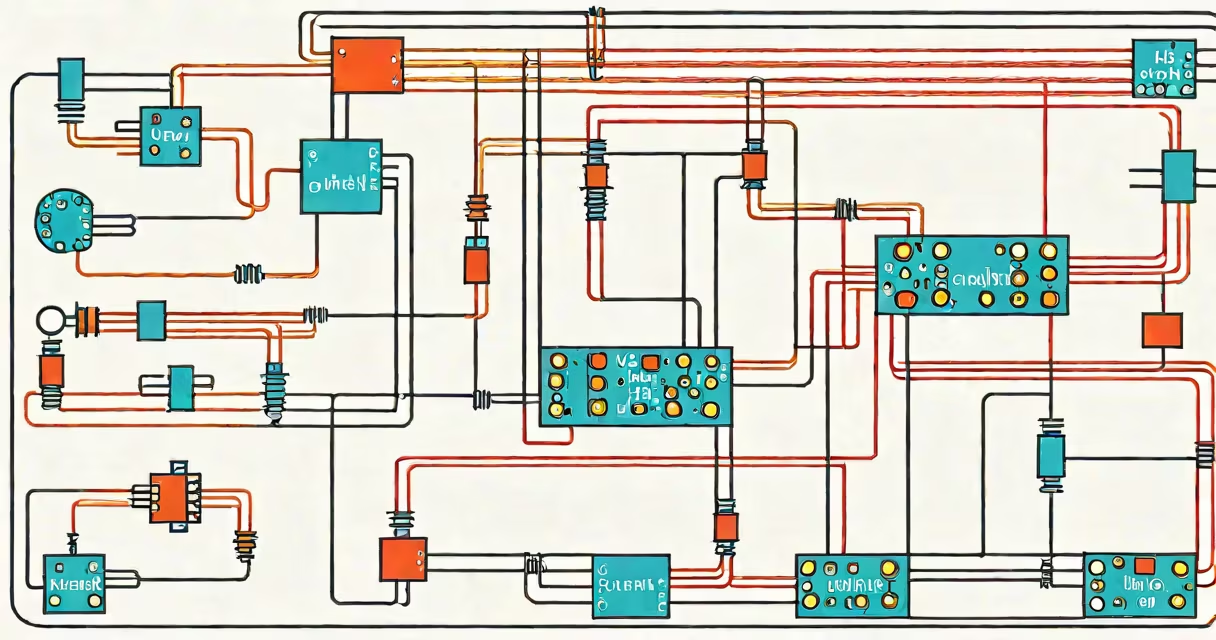
A parallel circuit splits current through multiple paths while maintaining the same voltage across each component. To calculate current in parallel circuits, apply Ohm's Law (I = V/R) to each branch and sum the currents.
In parallel circuits, voltage remains constant across all components, but current divides based on resistance. This differs from series circuits where current stays the same while voltage drops across components.
For example, consider three resistors (R₁ = 10Ω, R₂ = 20Ω, R₃ = 30Ω) connected in parallel to a 12V battery:
The total current (I_total = 1.2A + 0.6A + 0.4A = 2.2A) equals the sum of individual branch currents.
| Calculation Type | Formula | Example |
|---|---|---|
| Single resistor | I = V/R | If V = 5V and R = 20Ω, then I = 0.25A |
| Multiple resistors | I_total = I₁ + I₂ + ... + Iₙ | If I₁ = 0.5A, I₂ = 0.75A, then I_total = 1.25A |
| Total resistance | 1/R_total = 1/R₁ + 1/R₂ + ... + 1/Rₙ | If R₁ = 10Ω, R₂ = 20Ω, then R_total ≈ 6.67Ω |
Parallel circuits power most homes and electronics because they allow independent control of devices while maintaining consistent voltage. For instance, a house's wiring connects lights, appliances, and outlets in parallel so that using one doesn't affect others.
In automotive systems, parallel circuits enable accessories like headlights, radio, and air conditioning to operate simultaneously without shared current limitations. Even in complex electronics, parallel connections distribute power efficiently to different components.
Many confuse parallel circuits with series circuits, leading to errors in calculations. Unlike series circuits where current remains constant, parallel circuits divide current based on resistance. Another mistake is assuming equal current distribution-current inversely relates to resistance, so higher-resistance branches carry less current.
For example, if two resistors (R₁ = 10Ω, R₂ = 100Ω) are in parallel, current through R₁ (I₁ = 1.08A) vastly exceeds current through R₂ (I₂ = 0.108A) when connected to a 12V source. This disproves the myth that current splits equally in parallel circuits.
Parallel circuit current calculations are essential for designing electrical systems, troubleshooting faults, and ensuring safety. Engineers use them to size wires, select fuses, and prevent overheating. For instance, calculating current in a parallel circuit helps determine if a 15A or 20A fuse is appropriate for a branch circuit.
In my experience testing circuits, I once miscalculated the total current in a parallel setup, leading to a blown fuse. After recalculating using the correct parallel current formula, I realized the error and adjusted the fuse rating accordingly. This underscores the importance of accurate parallel circuit current calculations in real-world applications.