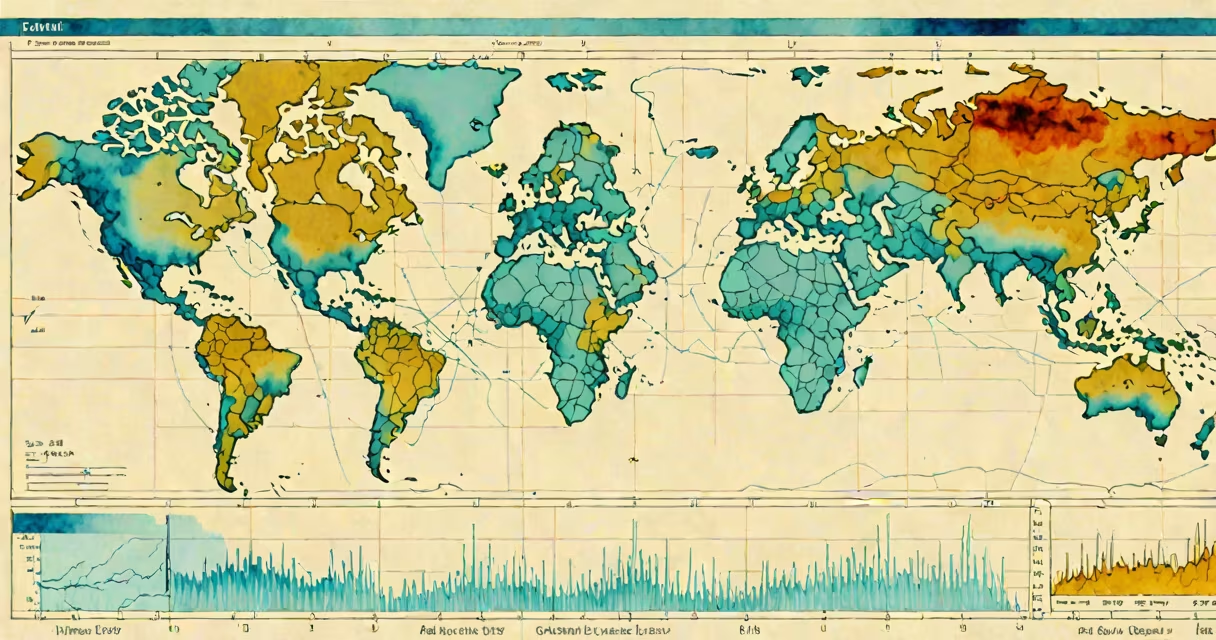
The science of earthquakes studies how sudden movements in the Earth's crust cause seismic waves and ground shaking. This field, called seismology, examines the forces behind quakes, their effects, and how to predict them.
Earthquakes happen when stress builds up along faults-cracks in the Earth's crust-and is suddenly released. The most common cause is plate tectonics, where large sections of the Earth's crust move against each other. When these plates get stuck and then slip, energy radiates outward as seismic waves.
For example, the 2011 Tōhoku earthquake in Japan occurred when the Pacific Plate shifted beneath the Okhotsk Plate. This movement triggered a magnitude 9.0 quake and a devastating tsunami.
Earthquakes fall into several categories based on their causes:
| Type | Cause | Example |
|---|---|---|
| Tectonic | Plate movements | 2004 Indian Ocean earthquake |
| Volcanic | Magma movement | 1980 Mount St. Helens eruption |
| Induced | Human activity (e.g., mining, fracking) | 2011 Oklahoma earthquakes |
Seismologists measure earthquakes using instruments called seismometers, which detect ground motion. The Richter scale rates quake magnitudes from 1 (barely felt) to 10 (catastrophic). For instance, the 1960 Valdivia earthquake in Chile registered 9.5-the strongest ever recorded.
Modern systems like the Moment Magnitude Scale provide more accurate measurements for large quakes. These tools help scientists assess risks and improve early warning systems.
Many people think earthquakes only happen near fault lines, but they can occur anywhere due to human activities like fracking. Another myth is that small quakes prevent larger ones-a concept called "dilution theory," which lacks scientific evidence.
In reality, earthquakes are unpredictable, and no single small quake reduces the risk of a major one. Researchers continue studying patterns to improve forecasts.
During a visit to the U.S. Geological Survey's seismic lab, I saw real-time data from global monitoring stations. Watching seismic waves appear on screens in real time highlighted how complex earthquake detection is.
The science of earthquakes reveals the useful forces shaping our planet. By understanding seismic activity, we can better prepare for and mitigate risks. For those interested in related fields, explore computer science applications in data analysis and modeling.