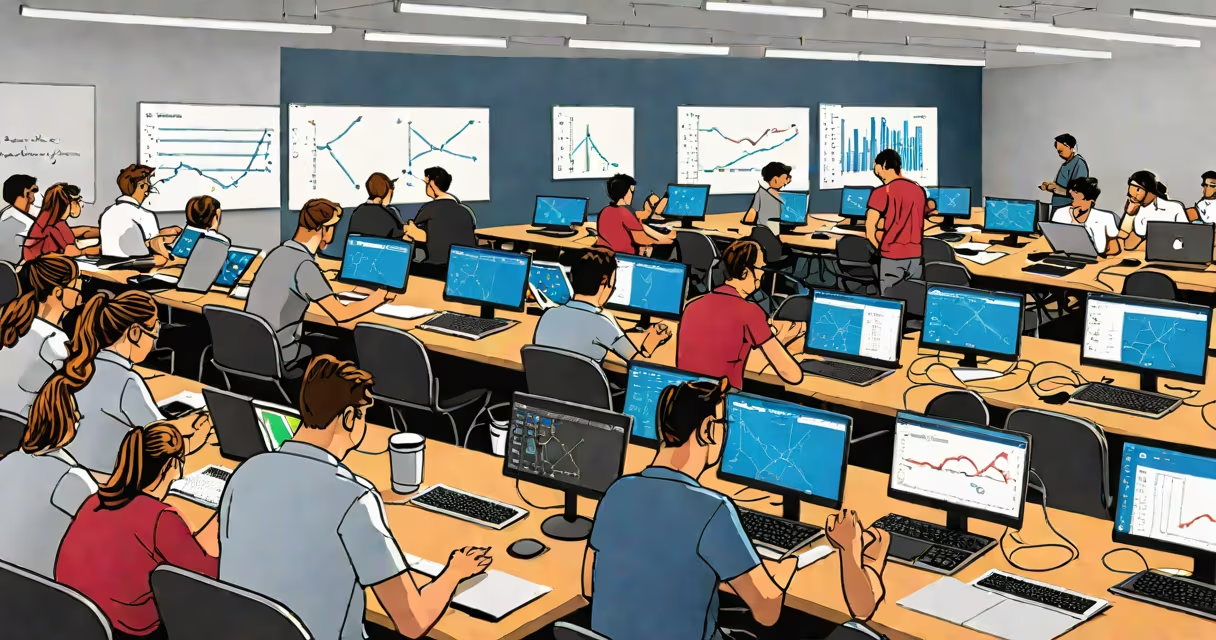
The Wharton Data Science Academy is an intensive program offered by the Wharton School of the University of Pennsylvania that teaches statistical analysis, programming, and data visualization through a business lens. It serves high school students, undergraduates, and professionals at different skill levels.
The academy runs multi-week summer sessions both online and in person. Students learn Python, R, and SQL alongside core statistical concepts. The curriculum emphasizes practical applications in finance, marketing, and operations using real-world datasets.
For example, undergraduates in the program analyze retail sales data to forecast demand, while high school students build predictive models for stock prices. Each cohort includes lectures, hands-on projects, and career workshops.
| Track | Duration | Prerequisites | Focus Areas |
|---|---|---|---|
| High School | 3 weeks | Basic algebra | Introductory statistics, Python basics, business case studies |
| Undergraduate | 6 weeks | Calculus, some programming | Machine learning, regression analysis, SQL databases |
| Professional | 8 weeks | Work experience | Advanced modeling, big data tools, business strategy |
A 2023 study by the Journal of Business Education found that graduates of business-focused data science programs had 27% higher employment rates in tech-adjacent roles compared to peers from purely technical programs.
Many assume the program is only for future data scientists. In reality, most participants come from business, economics, or healthcare backgrounds. For instance, one 2022 cohort included 40% pre-med students using the curriculum to analyze healthcare data trends.
Another myth is that prior coding experience is required. The high school track assumes no programming knowledge, starting with basic Python syntax before advancing to data visualization libraries like Matplotlib.
During a campus visit in 2021, I observed undergraduates presenting final projects that predicted customer churn for a fictional e-commerce company. Their models incorporated social media sentiment analysis-a technique rarely taught in introductory statistics courses. The blend of technical rigor and business relevance was striking.