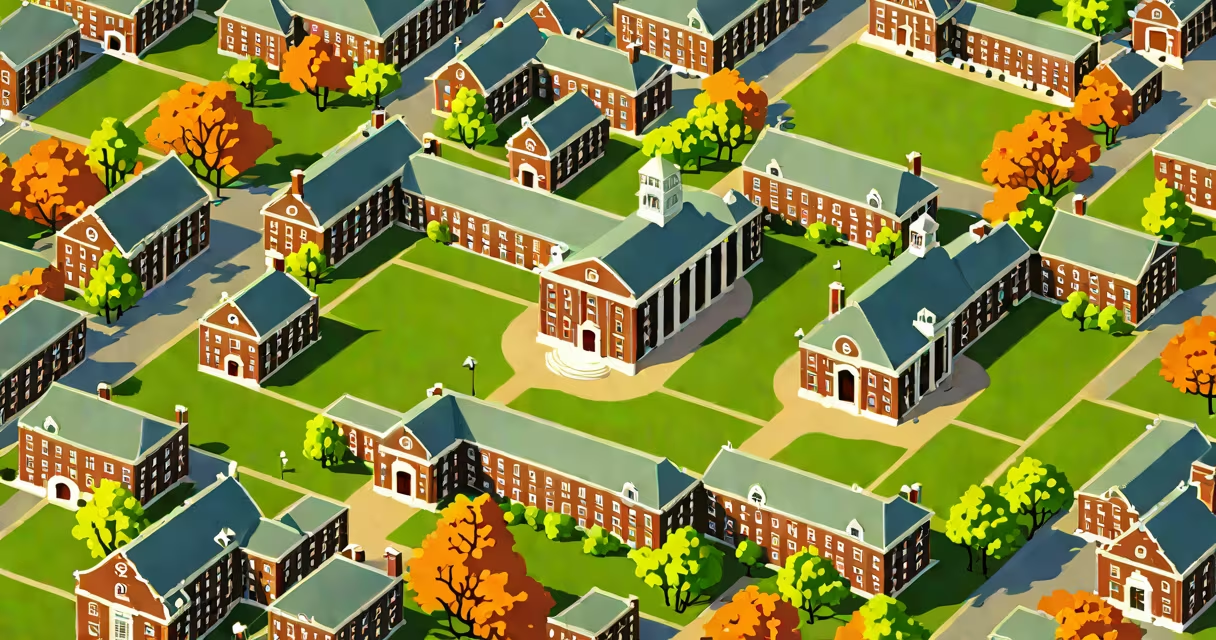
The Ivy League consists of eight private universities in the northeastern United States, renowned for academic excellence and competitive admissions. These institutions share a history dating back to colonial America, though they formed their athletic conference in 1954.
The term "Ivy League" originally referred to the athletic conference formed in 1954, but it quickly became associated with these schools' academic prestige. The name comes from the ivy plants that grow on many of these historic campuses. The oldest member, Harvard University, was founded in 1636, while the newest, Cornell University, was established in 1865.
All Ivy League schools share several key traits:
| School Name | Founded | Location | Undergrad Enrollment |
|---|---|---|---|
| Brown University | 1764 | Providence, Rhode Island | 7,106 |
| Columbia University | 1754 | New York City, New York | 8,836 |
| Cornell University | 1865 | Ithaca, New York | 15,183 |
| Dartmouth College | 1769 | Hanover, New Hampshire | 4,458 |
| Harvard University | 1636 | Cambridge, Massachusetts | 7,240 |
| University of Pennsylvania | td>1740Philadelphia, Pennsylvania | 8,527 | |
| Princeton University | 1746 | Princeton, New Jersey | 5,390 |
| Yale University | 1701 | New Haven, Connecticut | 6,494 |
Many people confuse the Ivy League with other elite institutions. While schools like MIT, Stanford, and the University of Chicago match or exceed Ivy League academic standards, they aren't members of the athletic conference. The Ivy League's unique combination of history, tradition, and academic reputation remains unmatched.
Ivy League schools are among the most selective in the world. Harvard's acceptance rate for the class of 2026 was just 3.16%. These institutions prioritize academic achievement, extracurricular involvement, and personal qualities in their admissions processes. Financial aid policies vary, but all Ivy League schools meet 100% of demonstrated financial need.
I once visited Columbia University's campus and was struck by the contrast between its urban location and the traditional collegiate architecture. This blend of old and new characterizes many Ivy League institutions, which maintain historic buildings while investing in modern facilities.
Ivy League schools produce numerous Nobel laureates, Pulitzer Prize winners, and leaders in various fields. According to the National Science Foundation, Ivy League institutions receive more research funding than any other universities. Their graduates often enter high-profile careers in law, medicine, business, and academia.
Beyond academics, Ivy League schools contribute to cultural and intellectual life. Yale's Beinecke Rare Book and Manuscript Library houses one of the world's largest collections of rare books and manuscripts. Princeton's art museum holds one of the finest university collections in the world.