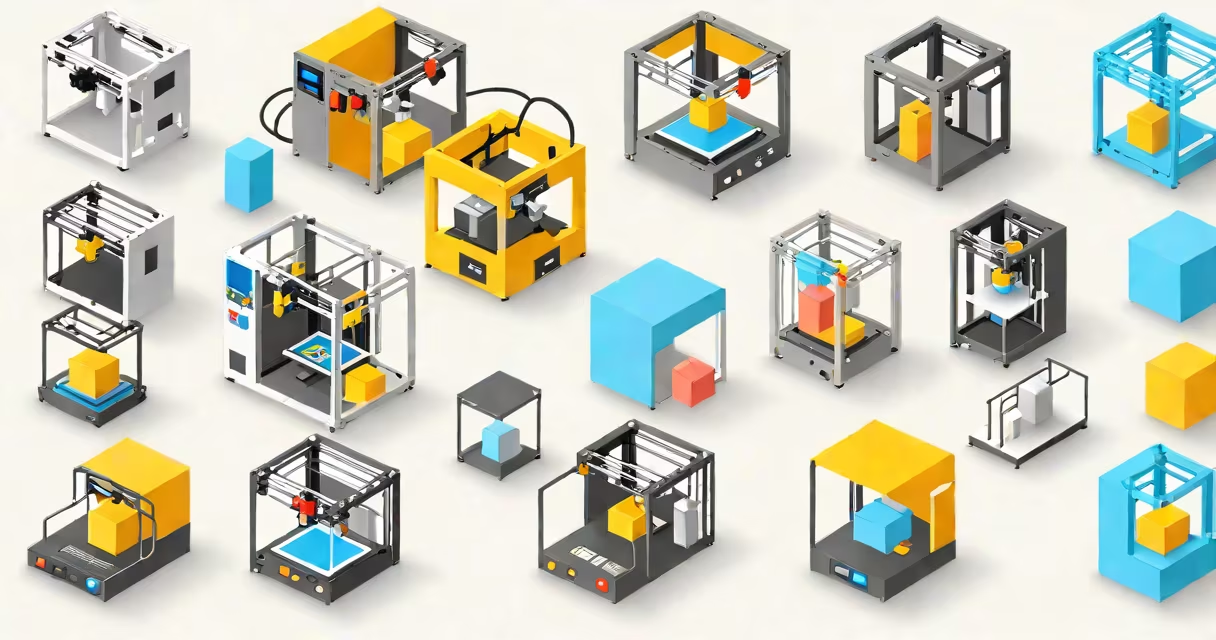
3D printers create objects by building them layer by layer using materials like plastic, resin, or metal. The main types are FDM, SLA, SLS, and DLP, each suited to different projects.
All 3D printers follow the same basic process: they read a digital design file and build the object layer by layer. However, the methods they use to create these layers differ.
The four most common types of 3D printers are:
| Type | Material Used | Resolution | Common Uses |
|---|---|---|---|
| FDM (Fused Deposition Modeling) | Thermoplastics (PLA, ABS, PETG) | 100-500 microns | Prototyping, toys, household items |
| SLA (Stereolithography) | Photopolymer resins | 25-100 microns | High-detail models, dental applications |
| SLS (Selective Laser Sintering) | Nylon, polyamide powders | 80-120 microns | Industrial prototypes, aerospace parts |
| DLP (Digital Light Processing) | Photopolymer resins | 10-100 microns | Jewelry, dental models, miniature figurines |
FDM printers work by extruding melted thermoplastic through a nozzle, building up layers to create the object. They are popular for hobbyists and small businesses due to their affordability and versatility.
For example, the Prusa i3 MK3S+ is a widely used FDM printer known for its reliability and ease of use. It can print with various materials, including PLA, ABS, and flexible filaments.
SLA printers use a UV laser to cure liquid resin into solid layers. They produce highly detailed prints with smooth surfaces, making them ideal for complex designs and small, complex parts.
The Formlabs Form 3 is a popular SLA printer used in industries like dentistry and jewelry design. It offers high resolution and precision, with layer thicknesses as low as 25 microns.
SLS printers use a laser to sinter powdered material, bonding the particles together to form solid layers. This process creates strong, durable parts suitable for industrial applications.
The EOS P 396 is an example of an SLS printer used in aerospace and automotive industries. It can print with materials like nylon and TPU, producing parts that can withstand high stress and temperature.
DLP printers use a digital light projector to flash a single image of each layer across the entire platform at once, curing the resin. This makes them faster than SLA printers for certain applications.
The B9 Creations B9 Core is a DLP printer known for its speed and precision. It is often used for creating detailed models and prototypes in fields like architecture and engineering.
When selecting a 3D printer, consider factors like material compatibility, resolution, build volume, and cost. For hobbyists, an FDM printer may be the best choice due to its affordability and versatility. For professionals requiring high detail and smooth surfaces, an SLA or DLP printer may be more suitable. Industrial applications often require the strength and durability of SLS printers.
I once used an FDM printer to create custom enclosures for electronic projects. The ability to print complex geometries and the wide range of available materials made it an invaluable tool for prototyping and testing designs.