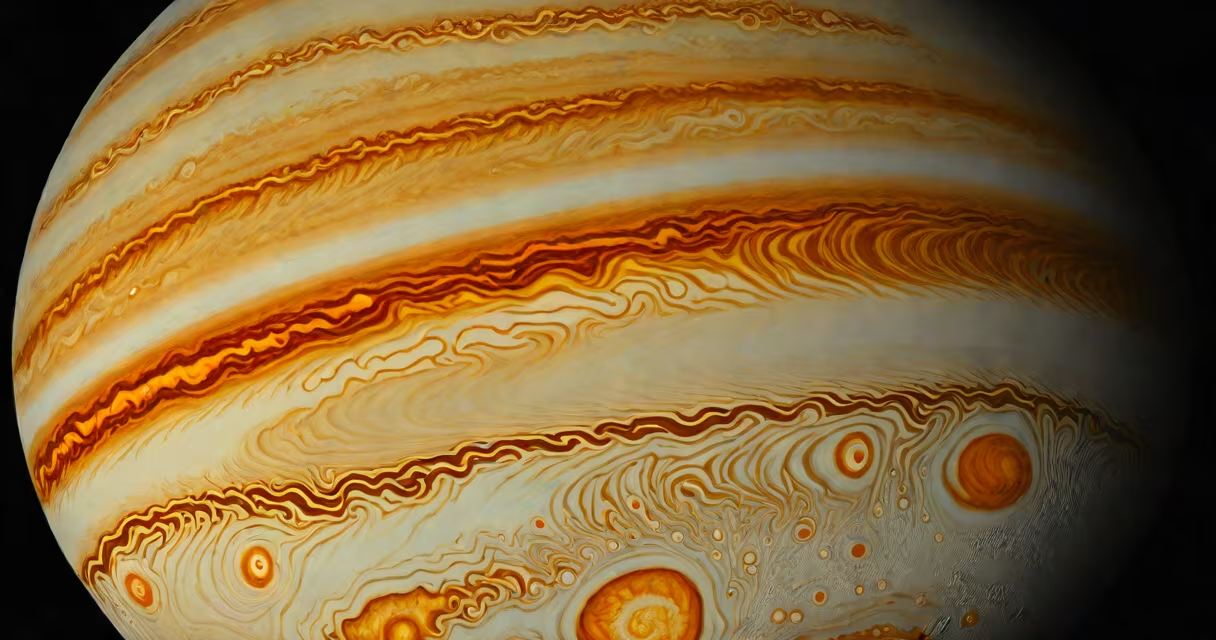
Jupiter appears as a pale yellow or tan disk with dark horizontal stripes (cloud bands) and a prominent reddish oval storm (the Great Red Spot) when viewed through most amateur telescopes. The planet's four largest moons-Io, Europa, Ganymede, and Callisto-are often visible as tiny points of light.
A telescope's aperture size determines how much detail you'll see. A 60mm refractor shows Jupiter as a small disk with faint bands, while a 10-inch reflector reveals finer details like the polar hoods and smaller storms.
The Great Red Spot is visible through telescopes 6 inches or larger, appearing as a faint smudge near Jupiter's southern equator. Its size varies between 10,000 and 16,000 miles wide-larger than Earth.
Jupiter's most striking features include:
Jupiter is brightest and closest to Earth during opposition, occurring every 13 months. In 2024, opposition happens on April 20 and June 10. The planet rises at sunset and remains visible all night, offering longer viewing windows.
For the clearest views, observe when Jupiter is highest in the sky, reducing atmospheric distortion. A steady atmosphere and high altitude improve visibility.
Many assume Jupiter's colors are vivid, but they appear muted through telescopes. The planet's pale yellow hue comes from ammonia clouds, while the Great Red Spot looks more like a faint smudge than a bold red mark.
Another myth is that Jupiter's moons are easily distinguishable. Through small telescopes, they appear as faint stars. Only larger telescopes reveal their disk shapes.
When I observed Jupiter through a 6-inch reflector in 2023, the cloud bands were visible, and the Great Red Spot appeared as a faint oval. Io's shadow transiting the disk was the most striking feature.