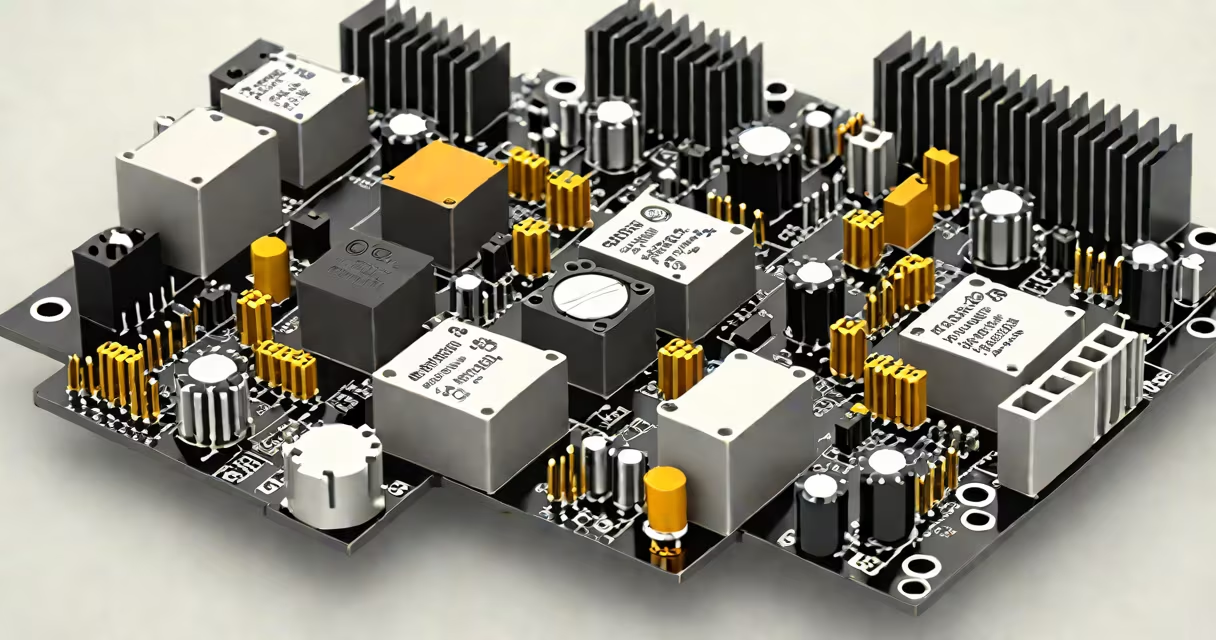
A buck boost converter is a DC-to-DC power converter that steps up or steps down voltage from its input supply to its output load. It combines buck (step-down) and boost (step-up) functionality in a single circuit.
These converters use semiconductor switches to alternate between buck and boost modes. The switch configuration determines whether the output voltage is higher or lower than the input voltage. A typical buck boost converter includes an inductor, diode, capacitor, and switching transistor.
When the switch is closed, current flows through the inductor, storing energy. When the switch opens, the inductor's magnetic field collapses, releasing stored energy to the output. This process repeats rapidly, creating a steady output voltage different from the input.
| Type | Characteristics | Typical Applications |
|---|---|---|
| Non-isolated | Shares a common ground between input and output | Battery-powered devices, automotive systems |
| Isolated | Uses a transformer for electrical isolation | Medical equipment, industrial control systems |
| Synchronous | Replaces diodes with transistors for higher efficiency | Computers, telecommunications equipment |
Buck boost converters are widely used in portable electronic devices, electric vehicles, solar power systems, and industrial equipment. They help maintain stable voltage levels despite varying input conditions.
For example, a laptop charger might use a buck boost converter to handle different input voltages from wall outlets worldwide while providing a consistent output to charge the battery. Similarly, solar panels produce variable voltage based on sunlight intensity, and buck boost converters help regulate this for home power systems.
Many people confuse buck boost converters with simple voltage regulators. Unlike linear regulators, which dissipate excess voltage as heat, buck boost converters efficiently convert voltage levels using inductive components.
Another common mistake is assuming all buck boost converters operate at the same frequency. In reality, their switching frequency varies depending on the application, typically ranging from 10 kHz to several MHz.
I once worked on a project where we needed to power sensors from a car battery (12V) but required 5V for operation. We used a buck boost converter to step down the voltage efficiently, improving battery life compared to a linear regulator.
Buck boost converters offer several benefits over traditional voltage regulation methods:
According to research from Texas Instruments, buck boost converters can achieve efficiencies up to 95%, making them ideal for battery-powered applications where energy conservation is critical.
When designing with buck boost converters, engineers must consider several factors:
The choice of inductor is particularly important, as it affects both efficiency and the ability to handle high currents. Ceramic capacitors are often preferred for their low equivalent series resistance (ESR) at high frequencies.
A buck boost converter is a versatile DC-DC converter that efficiently steps up or steps down voltage levels. Its ability to handle varying input conditions makes it indispensable in modern electronic design, from consumer devices to industrial applications.