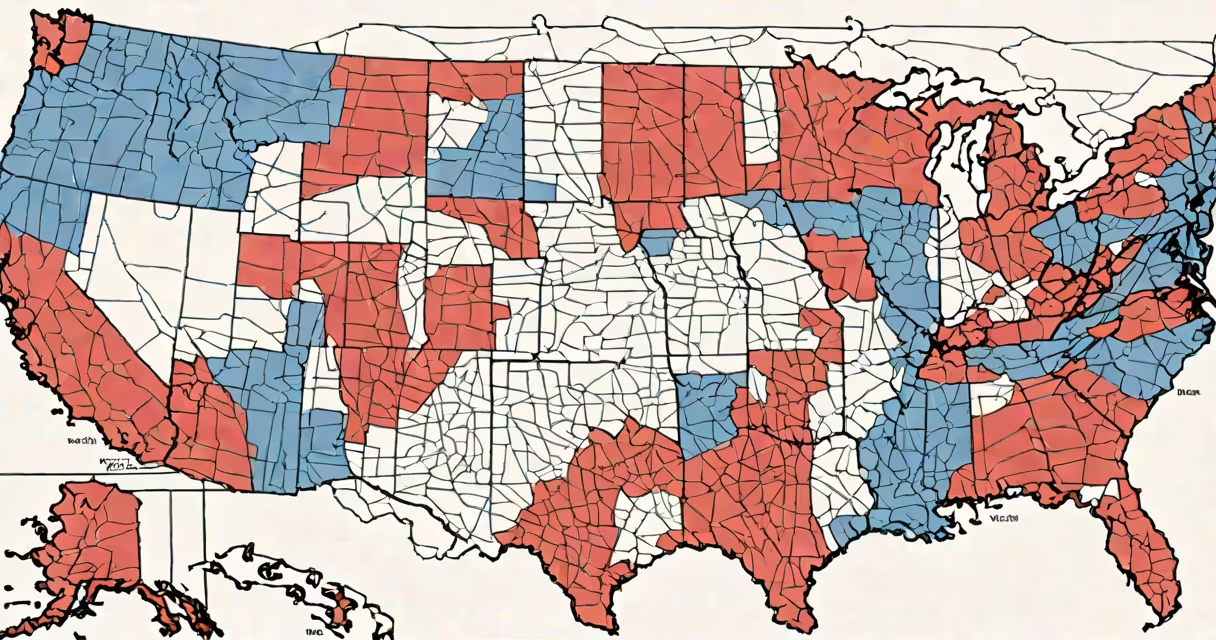
A red state is a U.S. state that consistently votes for Republican candidates in presidential elections. The term originates from media outlets' color-coding of election maps, where red represents Republicans and blue represents Democrats.
The red-blue division became popular during the 2000 election coverage, though it dates back to the 1988 election. The colors were chosen for contrast and visibility on TV screens, not because they align with party colors (the GOP's official color is actually red, while Democrats traditionally use blue).
Red states generally share conservative values, but they aren't monolithic. They often fall into these categories:
| Type | Examples | Key Characteristics |
|---|---|---|
| Traditionalist | Texas, Tennessee | Strong military presence, rural populations, and emphasis on states' rights |
| Religious | Utah, Alabama | High church attendance, socially conservative policies |
| Economic | Nevada, Florida | Business-friendly policies, lower taxes, tourism or retirement economies |
Red states tend to cluster in the South, Midwest, and Mountain West regions. Historical factors like the Civil War, Reconstruction, and the New Deal shaped this pattern. Many Southern states turned Republican after the Civil Rights Act of 1964, when conservative white Democrats switched parties.
Red states often prioritize limited government, lower taxes, gun rights, and opposition to abortion. Their voters tend to be older, white, and less educated than those in blue states. However, this isn't universally true-some red states have growing urban areas with progressive populations.
One misconception is that all red states are rural. While many are, some have major cities (e.g., Dallas, Phoenix, Charlotte). Another myth is that red states are uniformly poor-they include both economically struggling areas and wealthy ones like Wyoming and North Dakota.
Red states also aren't always deeply red. Some, like Arizona and Georgia, have tight margins in recent elections. Others, like Kansas and Maine, split their electoral votes.
During the 2020 election, I visited rural counties in a red state where Trump signs outnumbered Biden signs by at least 10-to-1. Locals emphasized personal freedom, distrust of government, and support for local businesses. This reinforced my understanding that red-state politics are deeply tied to cultural identity, not just policy preferences.
For more on how language shapes political identity, see adjectives describing red states.