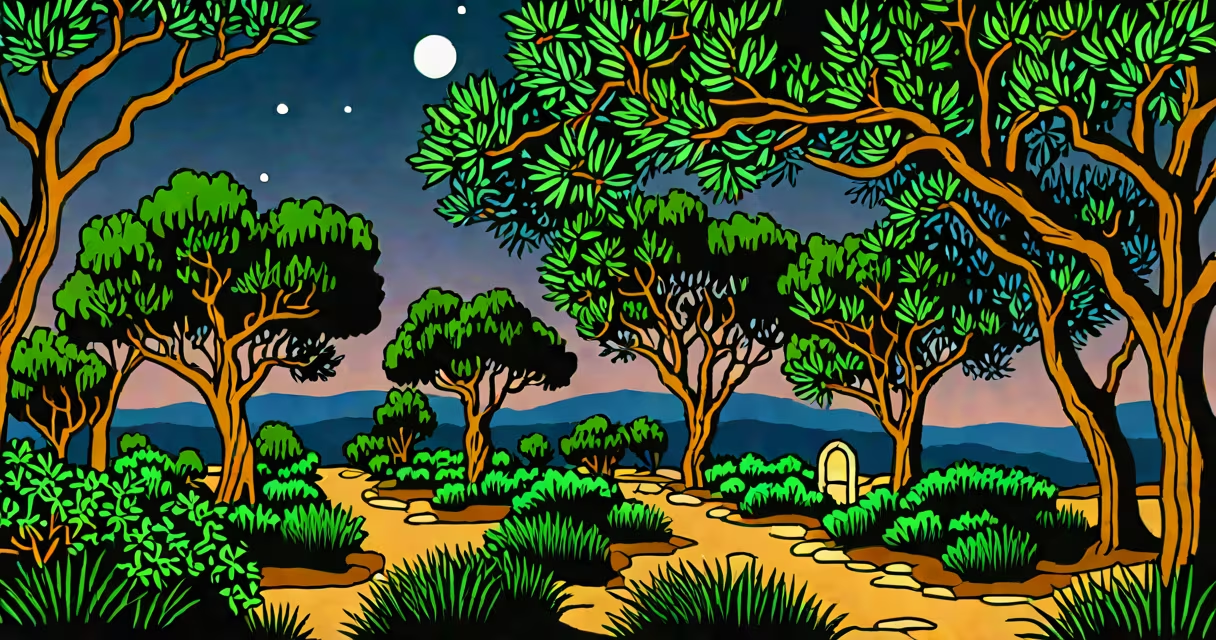
Gethsemane is the name of the garden where Jesus prayed before his arrest, representing his anguish and submission to God's will. The word itself comes from the Aramaic "Gat Shemanim," meaning "oil press," symbolizing the crushing pressure Jesus faced.
The Garden of Gethsemane is located at the foot of the Mount of Olives in Jerusalem. This area was likely an olive grove, which was common in the region. Today, the site is marked by several ancient olive trees and a church, the Basilica of the Agony, built by the Crusaders in the 12th century.
Jesus went to Gethsemane to pray because he knew his time of suffering was near. According to the Gospels, he asked his disciples to stay awake while he prayed, but they fell asleep. Jesus then prayed three times, asking God to "take this cup from me" but submitting to God's will, saying, "Not my will, but yours be done" (Luke 22:42).
After praying, Jesus was betrayed by Judas Iscariot, who led a group of soldiers to arrest him. This event marked the beginning of Jesus' passion, leading to his crucifixion. The name "Gethsemane" thus carries deep significance in Christian theology as a place of both agony and surrender.
Many people confuse Gethsemane with Golgotha, the site of Jesus' crucifixion. While both locations are central to the Passion narrative, they serve different roles: Gethsemane represents the prelude to suffering, whereas Golgotha is the culmination of Jesus' sacrifice., some mistakenly believe Gethsemane was a large, lush garden, but historical accounts suggest it was a modest olive grove.
Another misconception is that Jesus' prayer in Gethsemane was merely about fear of death. However, scholars argue that his anguish was deeper-it was a struggle between his human desire to avoid suffering and his divine mission to fulfill God's plan. This internal conflict makes Gethsemane a useful symbol of human vulnerability and divine obedience.
Today, Gethsemane remains a significant pilgrimage site for Christians worldwide. Visitors often reflect on the spiritual lessons of the garden, such as the importance of perseverance through trials and the value of trust in divine providence. The site also serves as a reminder of the human aspects of Jesus' life, making his story more relatable.
For many, the meaning of Gethsemane extends beyond its biblical context. It is seen as a metaphor for personal struggles and the need to surrender control to a higher power. This interpretation resonates with people facing their own challenges, offering comfort and guidance.
I visited Gethsemane during a trip to Jerusalem and was struck by the quiet solemnity of the place. The ancient olive trees, some believed to date back to the time of Jesus, stood as silent witnesses to history. The experience reinforced the timeless significance of Gethsemane as a place of reflection and spiritual renewal.
The meaning of Gethsemane goes beyond its geographical location; it is a useful symbol of human struggle, divine submission, and the profound lessons of faith. Understanding its significance can deepen one's appreciation of the biblical narrative and its relevance to modern life.