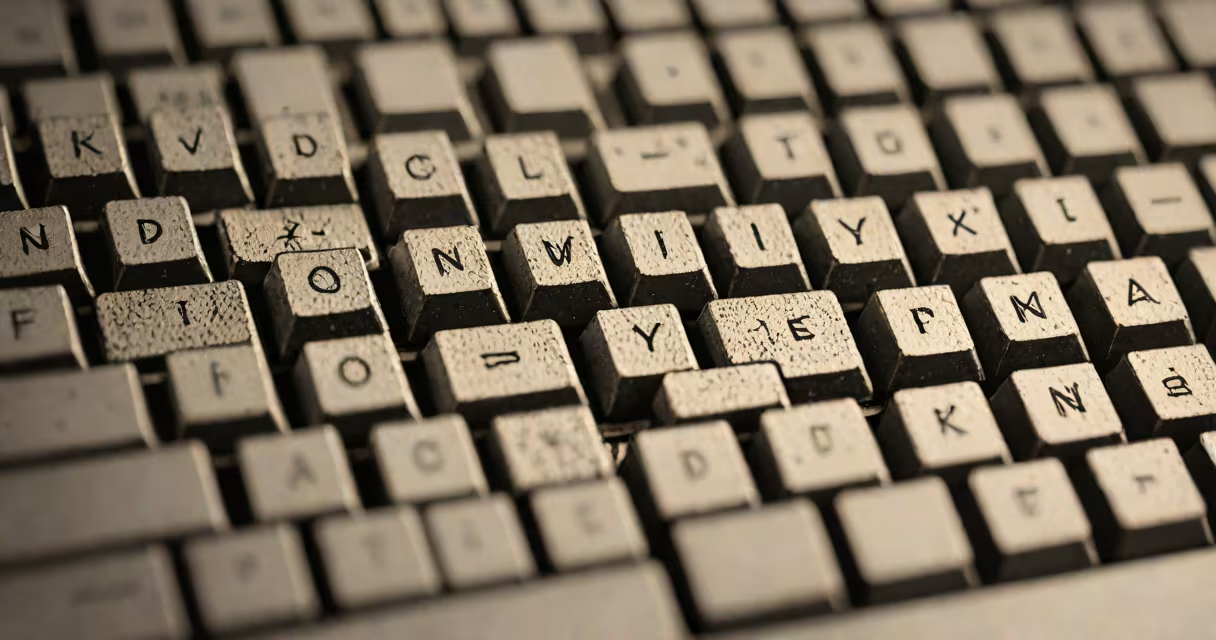
Worn keyboard letters are faded or missing characters on keycaps caused by prolonged use. They often appear on frequently pressed keys like "E," "T," and spacebars, revealing typing patterns.
Keycap legends (letters, numbers, symbols) are printed using methods like pad printing, laser etching, or dye-sublimation. These processes embed ink or dye into the plastic. Over time, friction from fingers wears away this layer, especially on keys pressed most often.
For example, the letter "E" typically wears first because it's the most frequent letter in English. On QWERTY keyboards, the "E" key is usually the third from the left on the top row. The spacebar also wears quickly due to its large surface area and frequent use.
| Type | Cause | Example Keys |
|---|---|---|
| Faded ink | Friction from fingers | E, T, A, O, I, spacebar |
| Shiny patches | Oils from skin | Finger home keys (F, J, D, K) |
| Missing legends | Aggressive cleaning or wear | Enter, backspace, shift |
Worn keyboards aren't just cosmetic-they can affect typing comfort and accuracy. Faded legends make keys harder to identify, potentially slowing typing speed. Shiny patches from oils can make keys slippery, increasing the risk of mistyped characters.
According to KeyChronicle, regular cleaning with isopropyl alcohol wipes can remove oils and extend keycap life. For severe wear, replacing keycaps is often the best solution.
Many assume worn keyboards are only an issue for heavy typists. However, even light users may notice wear over years. The problem isn't just frequency-it's also how hard you press keys. Some users press keys gently, while others hit them firmly, accelerating wear.
Another myth is that all keyboards wear equally. Rubber-dome keyboards often show wear faster than mechanical ones because their keycaps are typically thinner and less durable. Mechanical keyboards, with their sturdy keycaps, tend to hold up better over time.
To minimize wear, consider these strategies:
I once tested this by switching one of my mechanical keyboards to a lighter switch profile. After six months, the wear was noticeably less on the lighter-switch board compared to my usual heavy-press keyboard.
If legends are completely worn off or keys feel uncomfortable, it's time for new keycaps. Many manufacturers sell replacement sets, and custom keycaps are available in various materials like PBT or POM plastic, which resist shine and wear better than standard ABS plastic.