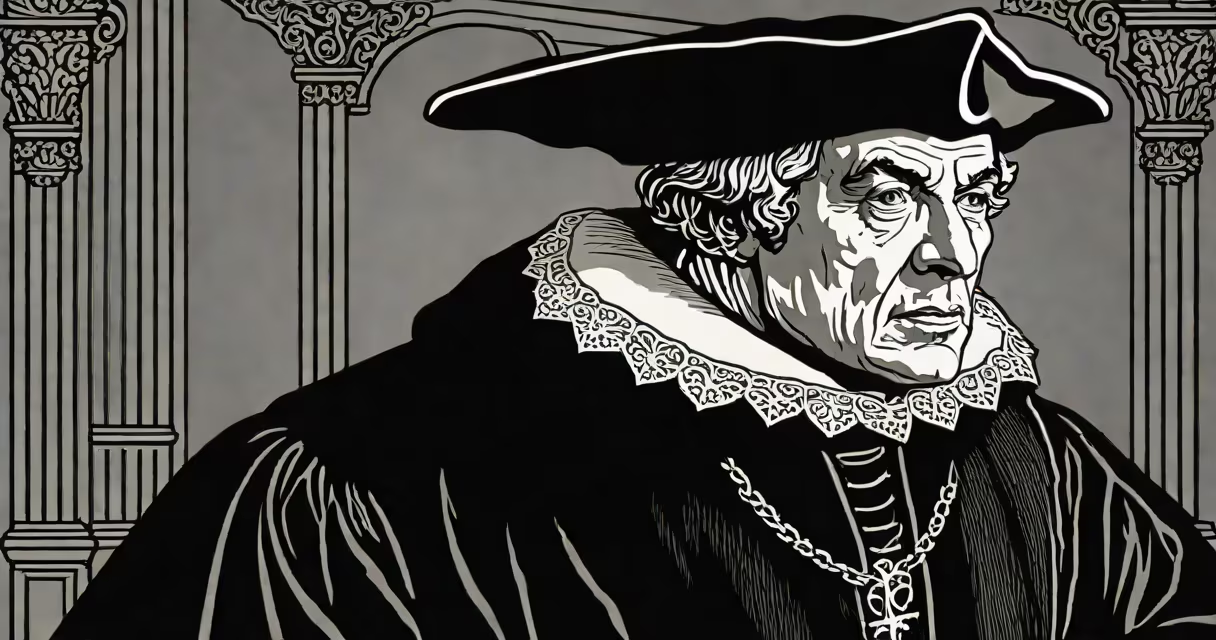
The play premiered at the Globe Theatre in London in 1960. Its success led to a 1966 film adaptation starring Paul Scofield, which won six Academy Awards including Best Picture. The story unfolds during the 1530s when Henry VIII sought to annul his marriage to Catherine of Aragon to marry Anne Boleyn.
More, then Lord Chancellor of England, opposed the king's actions on religious and moral grounds. Despite pressure from Henry VIII, Cardinal Wolsey, and later Thomas Cromwell, More refused to sign the Oath of Supremacy recognizing Henry as head of the Church of England. His principled stance cost him his position, freedom, and life.
The play features historical figures who interacted with Thomas More:
The play explores several interconnected themes:
| Theme | Description |
|---|---|
| Integrity | More's unwavering commitment to his principles despite immense pressure |
| Power vs. conscience | The conflict between political authority and personal morality |
| Friendship and loyalty | The complex relationships between More and other characters |
| Religious faith | The role of Catholicism in More's decision-making process |
Bolt's play takes creative liberties while maintaining historical accuracy in key aspects. The character interactions and dialogue are dramatized, but the core events - More's resignation, trial, and execution - follow historical records. The play captures the tension between church and state during the English Reformation.
One notable historical inaccuracy is the portrayal of Richard Rich. In the play, Rich betrays More by testifying against him. While Rich did testify against More, historical evidence suggests Rich may have been coerced or blackmailed rather than acting out of pure malice.
The play's enduring popularity stems from its exploration of timeless moral dilemmas. It has been performed worldwide and translated into numerous languages. The 1966 film adaptation remains one of the most acclaimed films about historical figures.
In my experience attending productions of A Man for All Seasons, the play's power lies in its ability to make historical events feel immediate and relevant. The moral choices faced by Thomas More resonate with contemporary audiences grappling with their own ethical decisions.
While the play focuses on historical events, its themes remain pertinent today. The tension between personal conviction and societal pressure is a universal human experience. As such, A Man for All Seasons continues to be studied and performed as a useful exploration of morality and integrity.