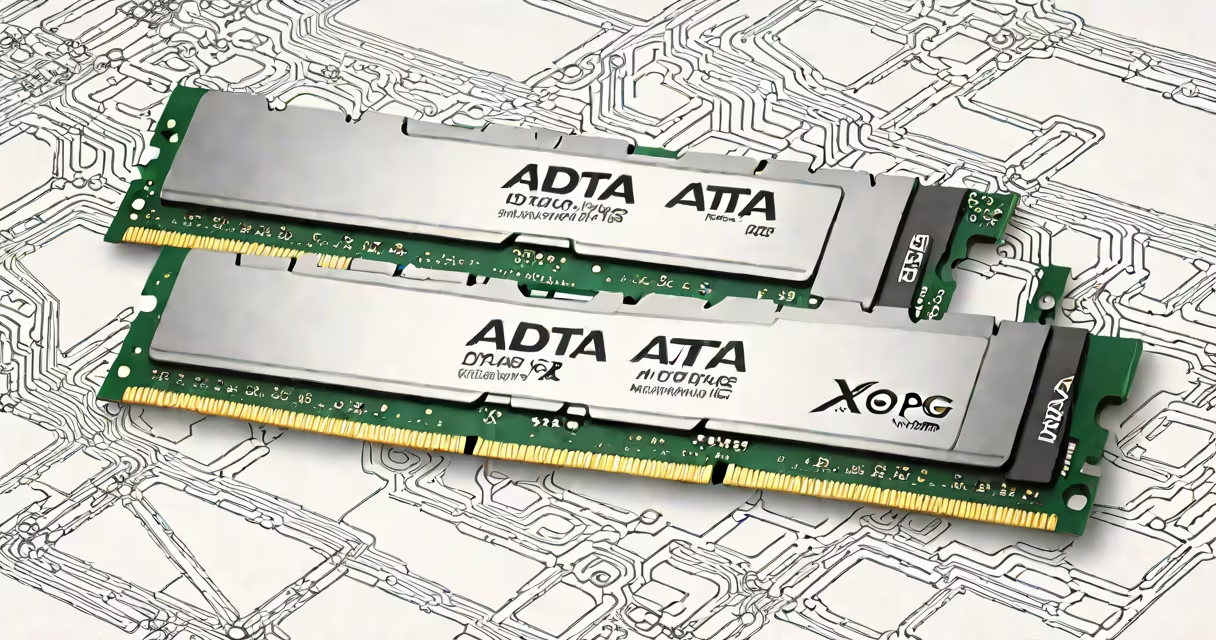
ADATA XPG RAM is high-performance memory designed for gaming and enthusiast PCs, offering speeds up to 5600MHz and low latencies for smoother gameplay and faster application loading.
Like other DDR4 memory, ADATA XPG RAM uses dual-data-rate architecture to transfer data twice per clock cycle. Its XMP 2.0 profiles allow automatic overclocking when paired with compatible motherboards. The modules use high-quality IC chips and advanced heat spreaders to maintain stability under heavy loads.
| Series | Speed (MHz) | Capacity Options | Key Feature |
|---|---|---|---|
| XPG SPECTRIX D50 | 3200-5600 | 8GB-32GB | RGB lighting with addressable LEDs |
| XPG GAMMIX D30 | 3000-3600 | 8GB-16GB | Low-profile design for small cases |
| XPG Z1 DIMM | 3200-3600 | 8GB-32GB | Standard height with RGB |
ADATA XPG RAM is primarily used in gaming desktops and high-performance workstations. Gamers choose it for its ability to reduce stuttering and improve frame rates in demanding titles. Content creators use it for faster rendering times in video editing and 3D modeling.
A common misconception is that more RAM is always better. While capacity matters for multitasking, speed and latency often have greater impact on performance. For most users, 16GB of fast RAM outperforms 32GB of slower memory in gaming scenarios.
ADATA XPG competes with brands like Corsair Vengeance, G.Skill Trident Z, and Kingston HyperX Fury. A key advantage is ADATA's use of high-quality IC chips sourced directly from manufacturers, which reduces failure rates. Independent tests show ADATA XPG modules maintaining stable performance at higher speeds than some competitors' budget lines.
One non-obvious fact: ADATA's manufacturing process includes rigorous temperature cycling tests, ensuring reliability in extreme conditions. This is particularly valuable for LAN tournament setups where systems run continuously for days.
When building my last gaming PC, I installed 32GB of ADATA XPG SPECTRIX D50 (two 16GB modules) into an ASUS ROG Strix B550 motherboard. After enabling XMP in BIOS, the system automatically boosted speeds to 5000MHz with timings of CL19-22-22-42. The process took less than five minutes and resulted in measurable improvements in game load times and multitasking performance.
According to ADATA's technical specifications, their highest-end modules achieve bandwidth up to 89.6GB/s, faster than standard DDR4-2133 modules at 17GB/s. This speed difference translates to real-world benefits like reduced texture pop-in in open-world games.