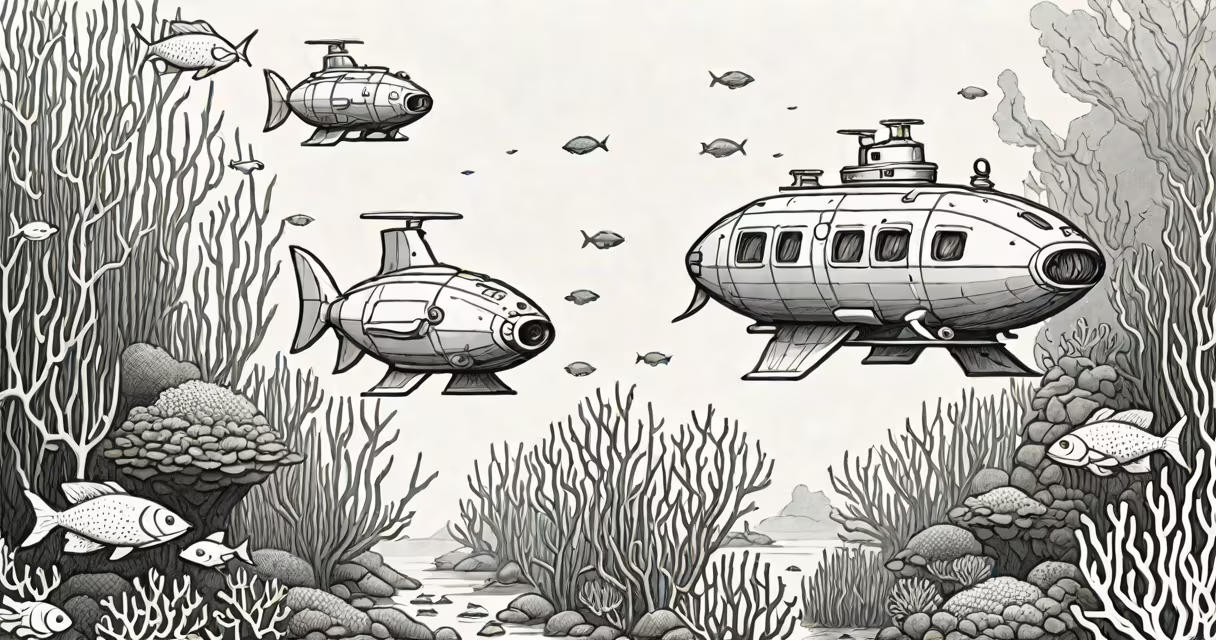
Autonomous underwater vehicles (AUVs) are self-propelled, unmanned robots designed to go through aquatic environments without real-time human control. These robotic submarines use sensors and algorithms to map seafloors, inspect pipelines, and study marine life.
AUVs operate independently using pre-programmed missions. They rely on sonar, cameras, and other sensors to gather data while going through through water. Unlike remotely operated vehicles (ROVs), which require constant human input, AUVs make decisions autonomously based on their programming.
For example, the NOAA's REMUS 6000 can dive to depths of 6,000 meters, mapping the ocean floor and identifying underwater hazards. Its autonomy allows it to adjust its path in real time if it encounters obstacles.
| Type | Depth Rating | Primary Use |
|---|---|---|
| Shallow Water AUVs | Up to 300 meters | Coastal monitoring, port security |
| Mid-Water AUVs | 300-1,500 meters | Pipeline inspection, environmental surveys |
| Deep-Water AUVs | 1,500-6,000+ meters | Seafloor mapping, deep-sea research |
Most AUVs fall into these three categories, though some specialized models exist for military or scientific applications. The Boeing Echo Seeker, for instance, is designed for mine detection in shallow waters.
AUVs play a critical role in ocean exploration, environmental monitoring, and industrial inspections. They are particularly useful in areas where human divers cannot safely go, such as deep-sea trenches or near underwater volcanoes.
One notable application is in offshore oil and gas operations. Companies use AUVs to inspect pipelines and rigs for damage or leaks. For example, the Ocean Infinity Armour AUV can survey thousands of kilometers of pipeline in a single mission, reducing the need for costly and risky human-diver inspections.
While both AUVs and ROVs are unmanned underwater vehicles, they differ in operation. ROVs are tethered to a surface vessel and controlled by human operators in real time. In contrast, AUVs operate independently, relying on pre-programmed missions and onboard decision-making systems.
A common misconception is that AUVs are always better than ROVs. However, ROVs excel in tasks requiring precise manipulation, such as repairing underwater equipment. AUVs, however, are ideal for large-scale surveys and data collection.
One of the biggest challenges in AUV development is energy efficiency. Since AUVs must operate for extended periods without recharging, engineers focus on optimizing battery life and power management. Another challenge is improving navigation accuracy in featureless environments, such as the open ocean.
In my experience testing an AUV prototype, I noticed how important real-time data processing is. The vehicle had to constantly adjust its path based on sensor feedback, which required sophisticated algorithms to ensure accurate navigation.
The future of AUVs lies in advancements in artificial intelligence and sensor technology. As AI improves, AUVs will become even more autonomous, capable of making complex decisions without human intervention., developments in renewable energy sources, such as hydrogen fuel cells, could extend mission durations.
According to a report by Markets and Markets, the global AUV market is expected to grow at a compound annual growth rate (CAGR) of 12.5%. This growth is driven by increasing demand for ocean exploration and offshore energy development.