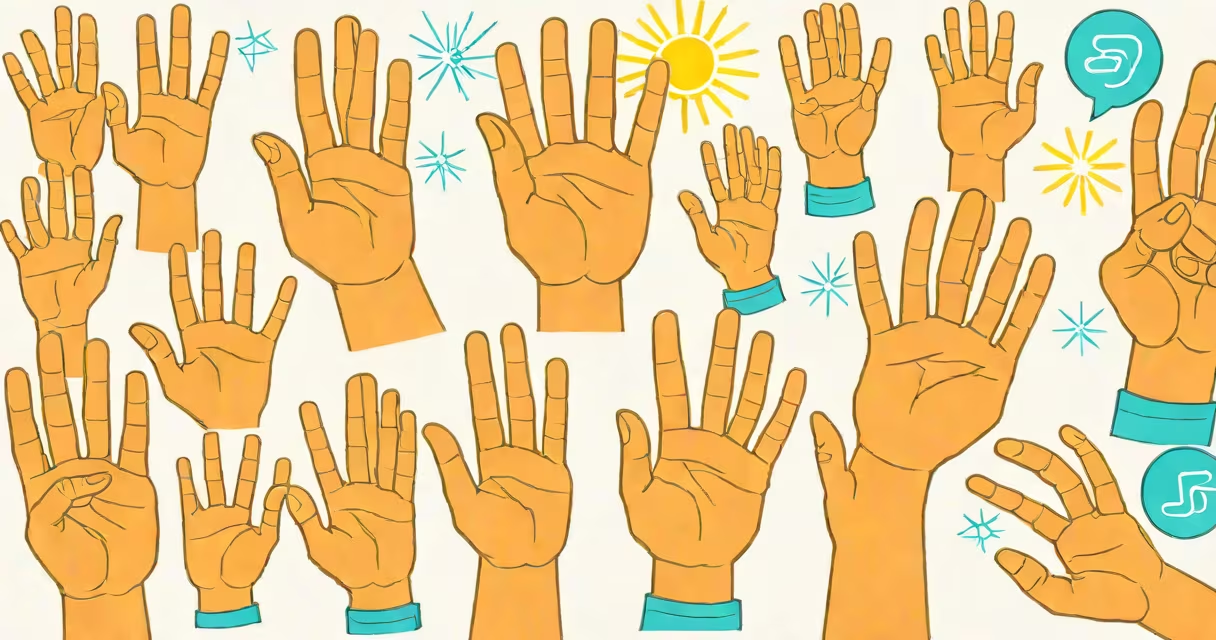
Basic ASL signs are simple hand gestures and facial expressions that form the foundation of American Sign Language (ASL) communication. These signs help beginners start conversations with Deaf and hard-of-hearing individuals.
ASL is a visual language that uses manual alphabet, hand shapes, movements, and facial expressions to convey meaning. Unlike spoken languages, ASL has its own grammar and syntax. For example, the sign for "thank you" combines a hand movement with a slight bow of the head.
Basic ASL signs fall into several categories:
Basic ASL signs are used in everyday situations to communicate with Deaf and hard-of-hearing individuals. They are also useful in environments where spoken language is difficult, such as noisy settings or when wearing masks. For instance, signing "thank you" acknowledges someone's help without needing to speak.
Many people confuse ASL with other forms of sign language, such as British Sign Language (BSL) or International Sign. While some signs may look similar, they are distinct languages with different grammars and vocabularies., ASL is not a universal language; it is primarily used in the United States and parts of Canada.
Another misconception is that ASL is simply a translation of English into signs. In reality, ASL has its own structure and rules, much like any other language. For example, the ASL sign for "love" is not a direct translation of the English word but represents the concept of love through a specific handshape and movement.
Imagine you're at a coffee shop and want to order a drink. You can use basic ASL signs to communicate your order without speaking. First, sign "Hello" to greet the barista. Then, sign "Coffee" by making a "C" shape with your hand and tapping it on your chest. Next, sign "One" by holding up your index finger. Finally, sign "Thank you" by bringing your fingers to your lips and moving your hand forward slightly while nodding your head.
Using basic ASL signs in this situation shows respect for Deaf culture and ensures clear communication. It also demonstrates the practicality of learning even a few basic signs.
Once you've mastered basic ASL signs, you can start learning more complex vocabulary and grammar. Resources like online courses, mobile apps, and local ASL classes can help you improve your skills. Practicing with native ASL users is also beneficial, as it provides real-world experience and feedback.
Remember, learning ASL is a gradual process. Start with basic signs and gradually build your vocabulary and fluency. With practice, you'll be able to have meaningful conversations with Deaf and hard-of-hearing individuals.