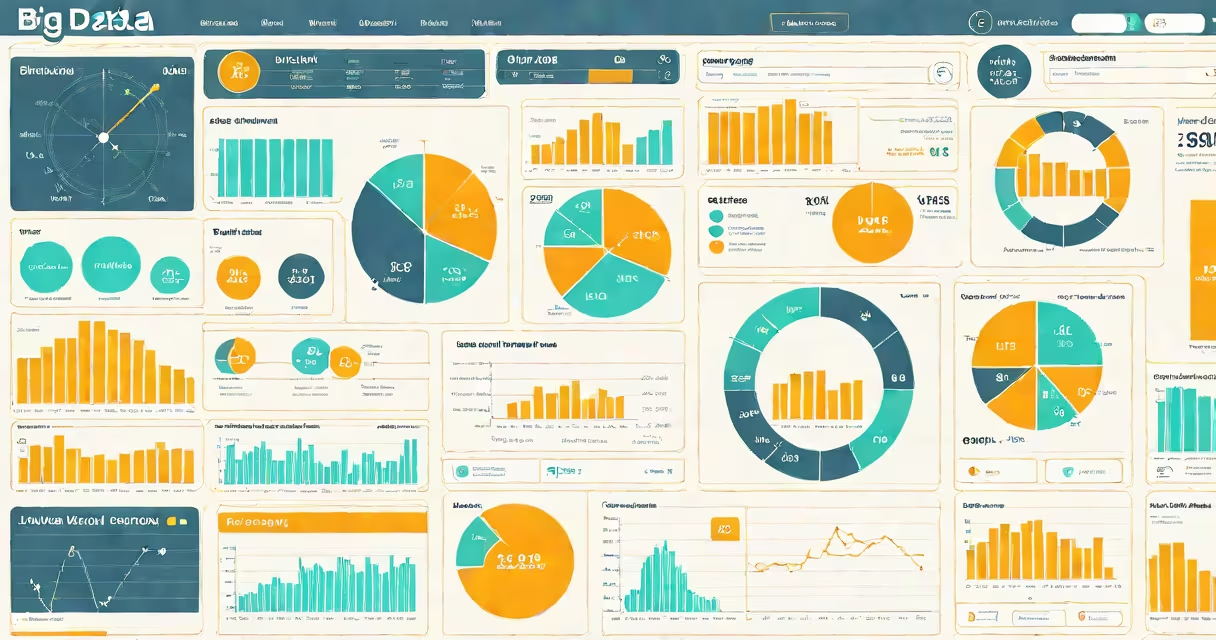
Big data business intelligence (BI) is the process of analyzing large datasets to uncover trends, patterns, and insights that inform business strategies. It combines big data technologies with traditional BI tools to support data-driven decision-making.
Big data BI processes begin with collecting structured and unstructured data from various sources, including social media, sensors, and transactional systems. This data is then cleaned, integrated, and stored in data warehouses or data lakes. Advanced analytics techniques, such as machine learning and natural language processing, are applied to extract meaningful insights. Finally, these insights are visualized through dashboards and reports, making them accessible to business users.
Big data BI systems consist of several key components:
Companies across industries use big data BI to improve operations, improve customer experiences, and drive growth. For example, retailers analyze customer purchase data to personalize marketing campaigns, while manufacturers monitor equipment sensors to predict maintenance needs. According to McKinsey & Company, businesses that use big data BI see a 5-6% increase in profits.
Many people confuse big data BI with traditional BI. While both involve analyzing data, big data BI handles larger, more complex datasets and uses advanced technologies like machine learning. Traditional BI relies on structured data and simpler analytics tools.
Another misconception is that big data BI is only for large enterprises. Small and medium-sized businesses also benefit from big data BI by using cloud-based solutions that scale with their needs. For instance, a local restaurant chain might use big data BI to analyze foot traffic and improve staffing schedules.
A retail company wants to improve its inventory management. It collects data from point-of-sale systems, online sales, and social media. Using big data BI tools, the company analyzes this data to identify which products sell fastest and which are likely to go out of stock. It then adjusts its inventory levels accordingly, reducing overstock and stockouts. The company also uses predictive analytics to forecast demand during peak seasons, ensuring it has enough inventory to meet customer needs.
The field of big data BI is evolving rapidly. Emerging technologies like artificial intelligence and edge computing are enhancing the capabilities of big data BI systems. According to Gartner, by 2025, 80% of enterprises will have adopted AI-driven analytics. These advancements will enable even more sophisticated data analysis, leading to better business outcomes.