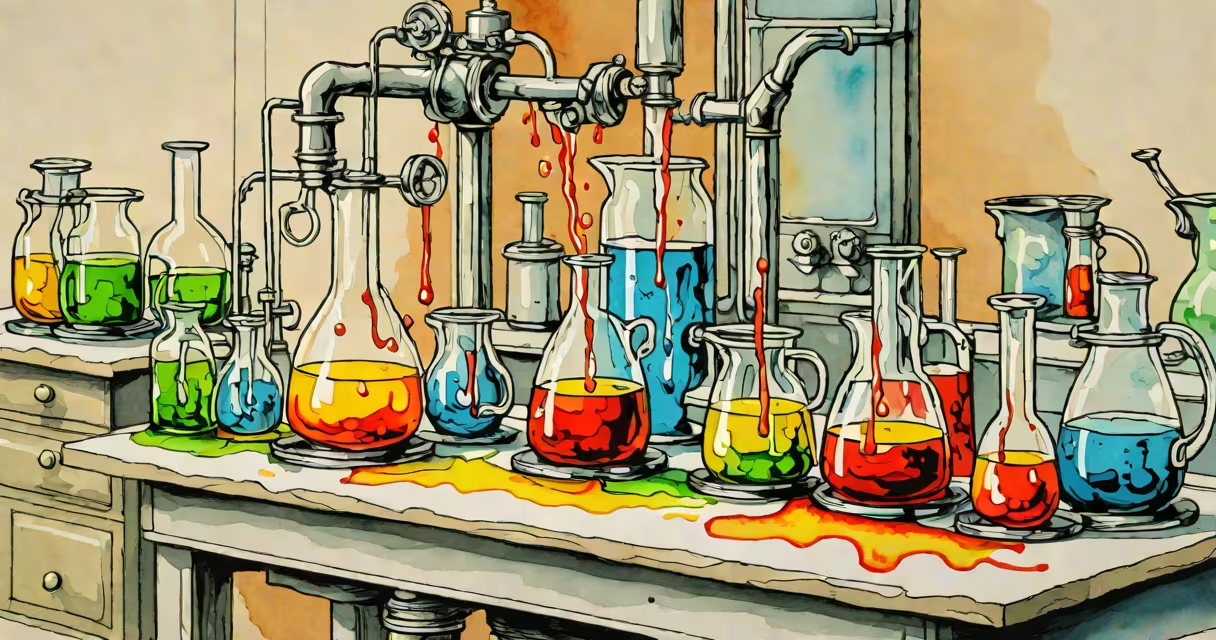
A boiling point is the temperature at which a liquid's vapor pressure equals the external pressure, causing it to rapidly turn into gas. This occurs when molecules gain enough energy to escape the liquid's surface.
When a liquid heats up, its molecules move faster. At the boiling point, these molecules have enough energy to overcome the liquid's surface tension and vapor pressure. The liquid transforms into gas bubbles, which rise and escape into the air.
For example, water boils at 100°C (212°F) at standard atmospheric pressure. However, at higher altitudes, where air pressure is lower, water boils at a lower temperature.
Boiling points vary based on substances and conditions:
| Type | Description | Example |
|---|---|---|
| Normal Boiling Point | Occurs at standard atmospheric pressure (1 atm) | Water: 100°C (212°F) |
| Elevation Boiling Point | Changes with altitude due to lower air pressure | Water in Denver: ~95°C (203°F) |
| Superheating | Liquid heated beyond its normal boiling point without boiling | Microwave-heated water exceeding 100°C |
Boiling points help identify substances and predict their behavior. Chemists use them to separate mixtures through distillation, a process that relies on different boiling points. For instance, ethanol boils at 78.37°C (173.1°F), much lower than water, allowing it to be separated from water-based solutions.
Many assume boiling points are fixed, but they change with pressure. A substance's boiling point decreases as altitude increases because lower air pressure allows vaporization at lower temperatures. This is why food cooks slower in high-altitude areas.
Another mistake is confusing boiling points with melting points. Melting points indicate solid-to-liquid transitions, while boiling points mark liquid-to-gas changes. For example, ice melts at 0°C (32°F), but water doesn't boil until 100°C (212°F).
Understanding boiling points is important in industries like pharmaceuticals, where precise temperatures ensure proper drug synthesis. In cooking, knowing boiling points helps determine cooking times and methods. For instance, sugars caramelize at higher temperatures than water boils, affecting baking outcomes.
In my lab work, I once observed how a mixture of liquids with different boiling points separated during distillation. The lower-boiling component vaporized first, leaving the higher-boiling component behind. This practical example reinforced the importance of boiling points in chemical processes.