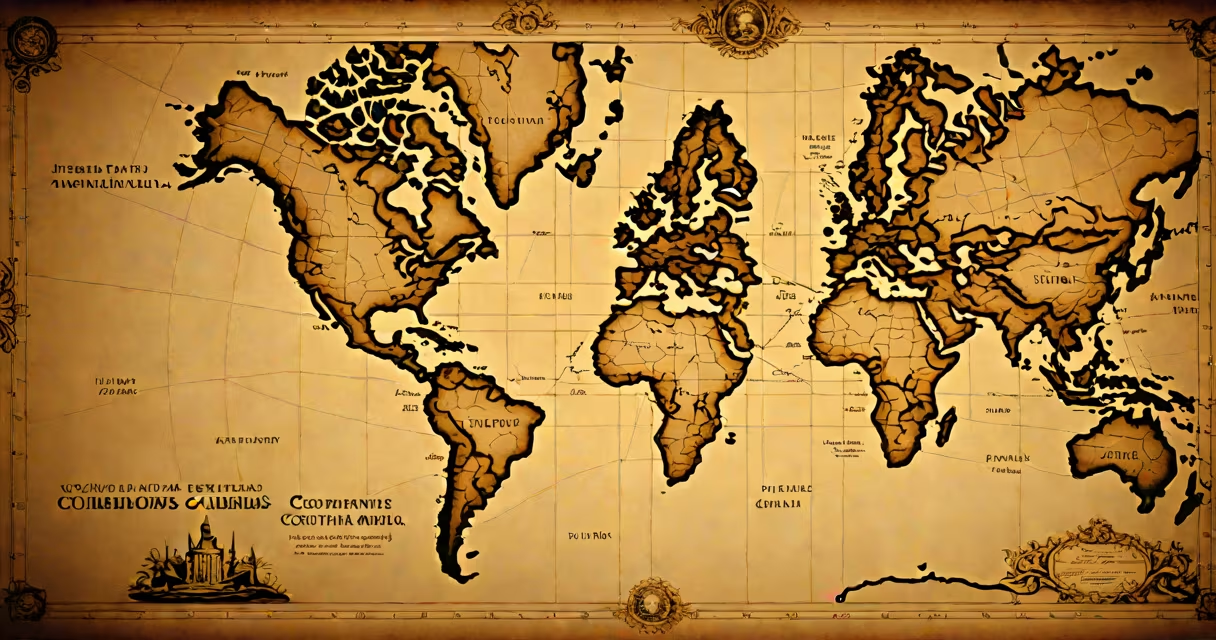
Christopher Columbus arrived at North America on October 12, 1492, during his first voyage across the Atlantic Ocean. This landing marked the beginning of sustained contact between Europe and the Americas, forever altering the course of history.
Columbus set sail from Spain on August 3, 1492, with three ships: the Niña, Pinta, and Santa María. His goal was to find a western sea route to Asia, but instead, he encountered the Bahamas, likely making landfall on an island called San Salvador. From there, he explored Cuba and Hispaniola (present-day Haiti and the Dominican Republic).
The three ships varied in size and purpose. The Santa María, the largest, served as the flagship. The Niña and Pinta were smaller caravels, designed for speed and maneuverability. Columbus commanded a crew of about 90 men, including sailors, soldiers, and even a few criminals who had been pardoned for their participation. The voyage took approximately 33 days, covering roughly 3,000 miles.
The arrival of Christopher Columbus in North America initiated widespread cultural exchange and conflict. It led to the Columbian Exchange, a transfer of plants, animals, technologies, and diseases between the Old World and the New World. This exchange profoundly impacted both hemispheres, altering ecosystems, economies, and populations.
However, Columbus did not actually reach North America proper. His initial landings were in the Caribbean. The first European contact with mainland North America occurred later, in 1497, when John Cabot reached Newfoundland. Despite this, Columbus' voyage is often credited as the beginning of European exploration and colonization of the Americas.
One prevalent myth is that Columbus proved the Earth was round. In reality, most educated Europeans of his time already accepted the Earth's sphericity. Columbus' primary goal was to find a new trade route to Asia, not to confirm the shape of the planet.
Another misconception is that Columbus discovered America. Indigenous peoples had inhabited the Americas for thousands of years before his arrival., Viking explorers had reached North America centuries earlier, around the year 1000, establishing a settlement at L'Anse aux Meadows in Newfoundland.
Columbus Day, celebrated annually on the second Monday of October in the United States, commemorates his arrival. However, the holiday has become controversial due to the negative impacts of colonization on indigenous populations. Some cities and states have replaced Columbus Day with Indigenous Peoples' Day to honor Native American cultures and histories.
According to historian Samuel Eliot Morison, Columbus' voyages "opened a new chapter in the history of mankind." While his achievements are undeniable, the consequences of his actions continue to be debated and reassessed.