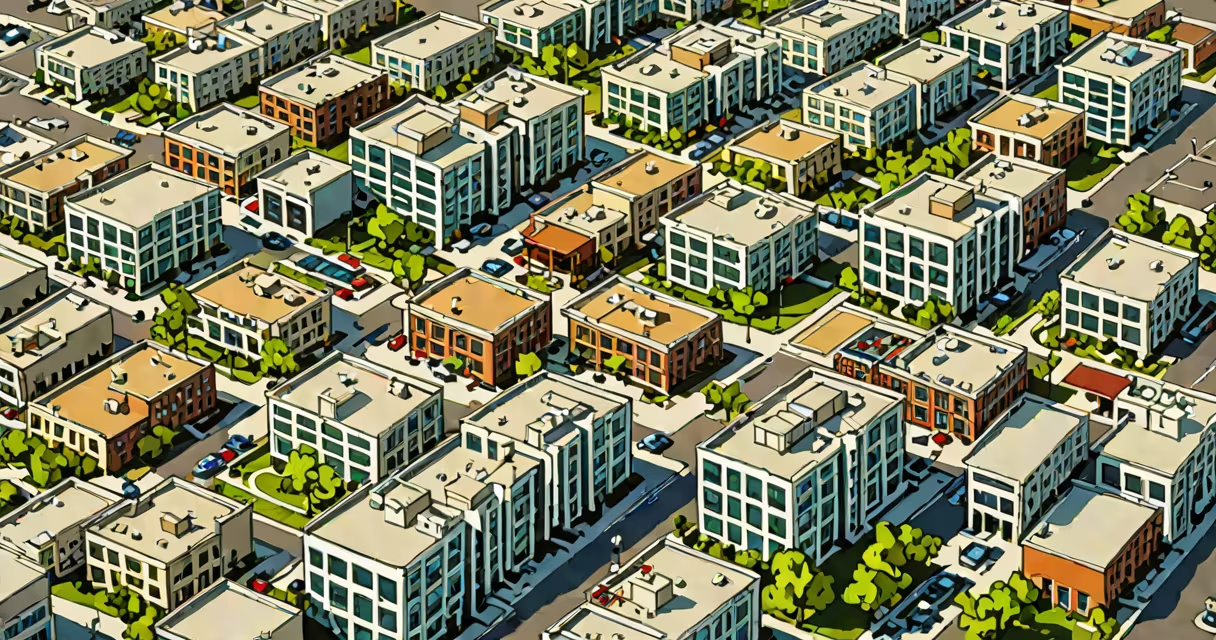
Commercial real estate (CRE) refers to properties used exclusively for business purposes, including offices, retail centers, industrial spaces, and hotels. These properties generate income through rent or capital appreciation, differing from residential real estate.
CRE generates revenue primarily through leases to businesses. Landlords charge tenants based on square footage, with common lease structures including gross leases (tenant pays base rent), net leases (tenant pays base rent plus some expenses), and modified gross leases (a hybrid of the two).
For example, a 10,000-square-foot office building might lease for $20 per square foot annually, generating $200,000 in base rent before additional expenses. Landlords often hire property managers to handle maintenance, tenant relations, and rent collection.
| Type | Description | Example |
|---|---|---|
| Office | Spaces for professional services, from single-tenant buildings to skyscrapers | 10-story downtown office tower |
| Retail | Properties housing stores, restaurants, and service businesses | Regional shopping mall |
| Industrial | Warehouses, manufacturing facilities, and distribution centers | Amazon fulfillment center |
| Multifamily | Apartment complexes with five or more units | High-rise apartment building |
| Special Purpose | Properties serving unique functions like schools or churches | Movie theater complex |
Another misconception involves tax treatment. While both property types may qualify for depreciation deductions, CRE owners often face higher capital gains taxes due to larger sale prices and potential recapture of depreciation.
CRE offers higher income potential and longer lease terms than residential properties. For instance, a well-located office building might yield 6-12% annual returns, compared to 1-4% for single-family homes. However, CRE requires larger upfront investments and carries higher risks, such as vacancy rates and market fluctuations.
During my work with a small investment firm, we analyzed a vacant retail strip center. After renovations and securing new tenants, the property's value increased by 30% within two years, demonstrating CRE's potential for significant appreciation.