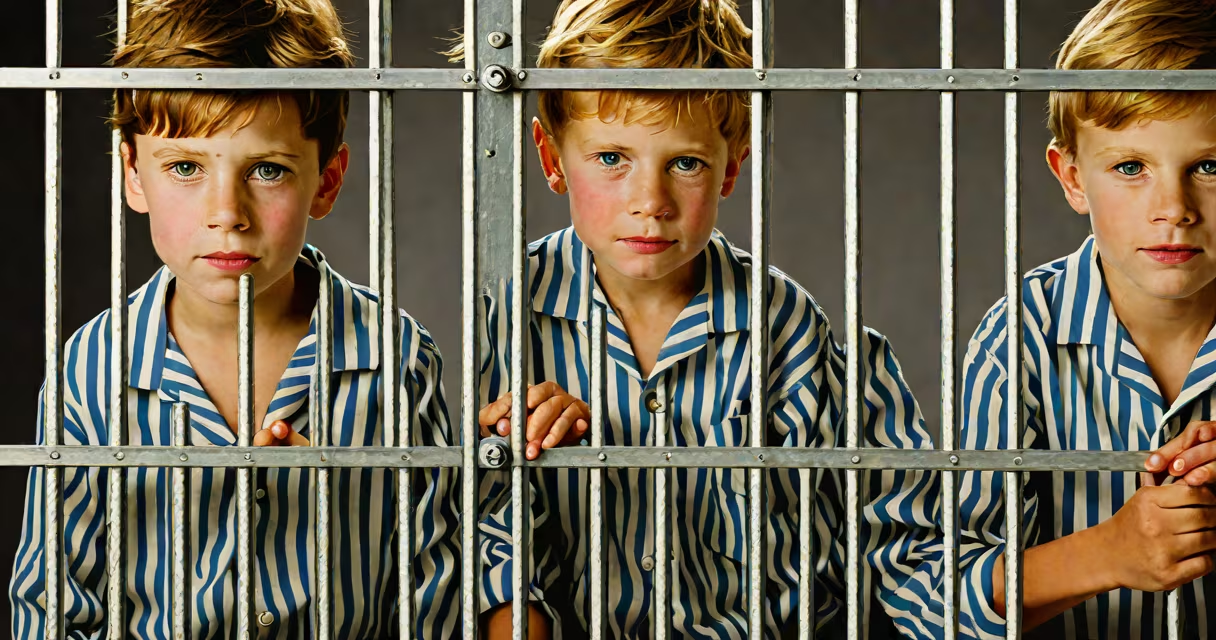
De Jongen in de Gestreepte Pyjama is a historical fiction novel by Irish author John Boyne, narrated by a nine-year-old German boy who befriends a Jewish boy imprisoned in a concentration camp during World War II.
The novel is told from the perspective of Bruno, a naive and curious German boy whose father is promoted to commandant of Auschwitz. Bruno moves with his family to a desolate area near the camp and becomes fascinated with the strange "farm" he sees from his window. He meets Shmuel, a Jewish boy imprisoned in the camp, and forms an unlikely friendship despite the barbed wire fence that separates them.
The story revolves around two primary characters: Bruno, the innocent German boy, and Shmuel, the Jewish prisoner. The setting is primarily Auschwitz during World War II, with the narrative unfolding in the stark contrast between Bruno's comfortable home and the harsh reality of the concentration camp.
De Jongen in de Gestreepte Pyjama is widely used in educational settings to teach students about the Holocaust and the horrors of World War II. Its simple yet useful narrative makes complex historical events accessible to younger readers. The novel is often paired with historical context and discussions about prejudice, discrimination, and the importance of empathy.
Some readers mistake the novel for a purely historical account, but it is a work of fiction. While it draws inspiration from real events, the characters and specific plot points are fictionalized to create a compelling narrative., the novel's ending is often debated among readers, with some interpreting it as a metaphorical representation of the Holocaust's impact rather than a literal event.
According to the United States Holocaust Memorial Museum, the novel is one of the most frequently taught books about the Holocaust in schools worldwide. Its emotional resonance and accessibility make it a useful tool for educating young people about this dark period in history.
When I first read De Jongen in de Gestreepte Pyjama, I was struck by the simplicity of the prose and the depth of emotion it evoked. The contrast between Bruno's innocence and the grim reality of the concentration camp created a profound sense of sadness and reflection. It's a book that stays with you long after you've turned the last page.
De Jongen in de Gestreepte Pyjama is a poignant exploration of friendship and the Holocaust, told through the eyes of a young boy. Its useful narrative and educational value make it a significant work of historical fiction.