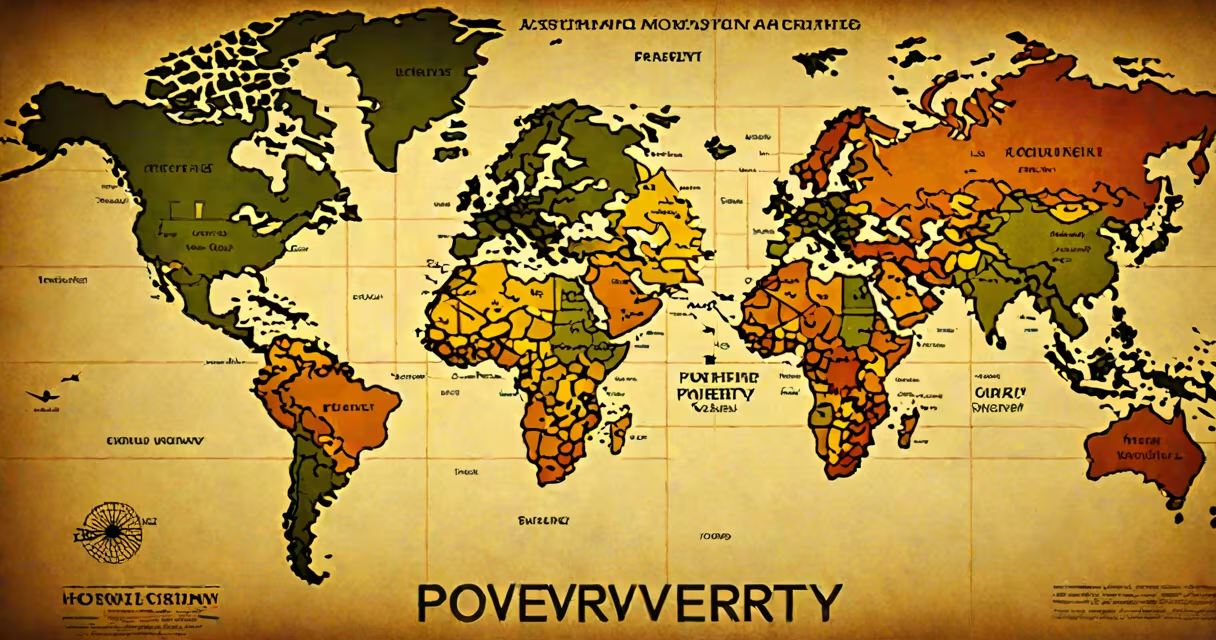
Poverty is a state of deprivation where individuals lack sufficient resources to meet basic needs like food, shelter, and healthcare. It is measured using income thresholds, consumption levels, and multidimensional indices.
Poverty is quantified through various metrics. The most common is the poverty line, which defines the minimum income required for basic living standards. For example, the U.S. federal poverty line for a family of four was $27,756 in 2023.
Other measures include:
| Type | Description | Example |
|---|---|---|
| Absolute Poverty | Lack of resources to meet basic survival needs | Families in rural Sub-Saharan Africa living on less than $1.90/day |
| Relative Poverty | Income lower than the societal average | A single parent in the U.S. earning $15,000/year while the median income is $67,000 |
| Situational Poverty | Short-term financial hardship due to unexpected events | A worker laid off during the COVID-19 pandemic |
| Generational Poverty | Cycle of poverty passed down through families | Children in Appalachia whose parents and grandparents lacked education and stable employment |
Many assume poverty is solely about low income. However, it also involves limited access to education, healthcare, and social services. For instance, a family earning above the poverty line may still struggle with food insecurity or unaffordable childcare.
Another misconception is that poverty only exists in developing nations. In reality, 34 million Americans lived in poverty in 2021, according to the U.S. Census Bureau.
The U.S. poverty rate was 11.5% in 2021, with significant disparities among racial and ethnic groups. For example, 19.5% of Black Americans and 17% of Hispanic Americans lived in poverty, compared to 8.2% of White Americans (U.S. Census Bureau).
Poverty affects access to opportunities. Children growing up in poverty are more likely to drop out of school, face higher rates of chronic illness, and earn lower wages as adults. Programs like SNAP (Supplemental Nutrition Assistance Program) and Medicaid aim to alleviate these challenges.
While poverty measures absolute deprivation, inequality compares differences in income and wealth within a population. A country can have low poverty rates but high inequality if wealth is concentrated among a small group. For example, Brazil reduced poverty but remains one of the most unequal societies globally (World Bank).
Understanding both concepts is important for effective policy-making. While poverty reduction focuses on lifting people above the poverty line, addressing inequality requires redistributive policies like progressive taxation and social welfare programs.