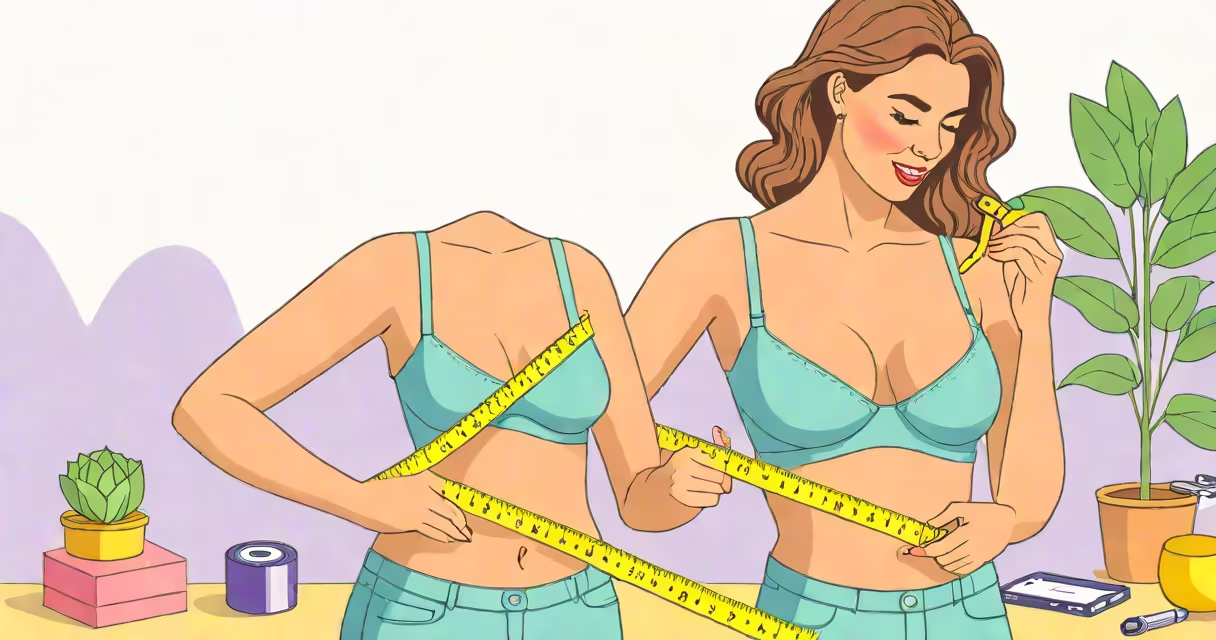
To find your bra size, measure your ribcage and bust, then subtract the smaller number from the larger one to determine your cup size. The most accurate way to find your bra size is to measure yourself while wearing a non-padded, well-fitting bra.
Your band size is the measurement around your ribcage, just below your bust. Use a soft measuring tape to circle your ribcage snugly, ensuring the tape is parallel to the floor. Round to the nearest whole number. If the number is even, that's your band size. If it's odd, add 1 inch to find your band size.
Measure around the fullest part of your bust, keeping the tape parallel to the floor. Round to the nearest whole number. Subtract your band size from your bust size to find your cup size. For example, if your bust measures 36 inches and your band size is 32 inches, your cup size is D (36 - 32 = 4).
Use the difference between your bust size and band size to find your cup size. The chart below shows the corresponding cup sizes based on the difference.
| Difference (inches) | Cup Size |
|---|---|
| 0 | AA |
| 1 | A |
| 2 | B |
| 3 | C |
| 4 | D |
| 5 | DD |
| 6 | DDD |
| 7 | DDDD |
An ill-fitting bra can cause discomfort, poor posture, and even health issues like back pain. According to a study by the University of Portsmouth, 80% of women wear the wrong bra size. Accurate measurements ensure a comfortable fit and proper support.
When I measured myself, I discovered my band size was 34 inches and my bust size was 38 inches. Subtracting 34 from 38 gave me a 4-inch difference, which corresponds to a D cup. This helped me find bras that fit perfectly, improving my comfort.
Many women make the mistake of rounding up their band size, leading to a loose fit. Others measure over clothing, which can add inches and result in an inaccurate size. Always measure over a well-fitting, non-padded bra for the most accurate results.
Another common error is assuming that a larger cup size always means a bigger bra. However, cup size is relative to the band size. For example, a 34D has smaller cups than a 36D because the band size affects the cup volume.
If you're still unsure about your size, consider consulting a professional bra fitter at a lingerie store. They can provide personalized advice and help you find the best-fitting bras for your body.
Finding your bra size accurately ensures comfort, support, and confidence. By measuring your band and bust sizes correctly and using the right cup size chart, you can avoid common fitting mistakes and enjoy a well-fitted bra every time.