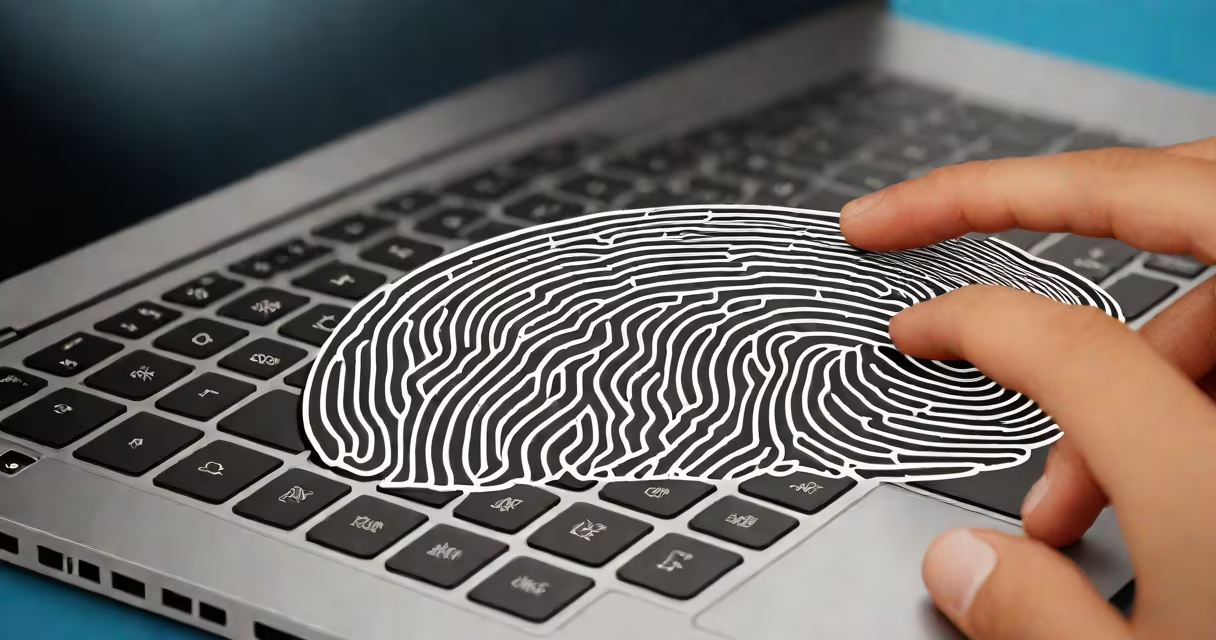
Fingerprint computer security is a biometric authentication method that uses a person's unique fingerprints to verify their identity and grant access to devices or systems. This technology replaces traditional passwords with a physical trait that is nearly impossible to replicate.
Fingerprint scanners capture an image of the ridges and valleys on a fingertip. The scanner converts this image into a digital template, which is stored securely on the device. When a user places their finger on the scanner, the system compares the live scan to the stored template. If they match, access is granted.
Most modern fingerprint scanners use capacitive or optical sensors. Capacitive sensors detect the electrical currents between the ridges and valleys, while optical sensors take a high-resolution image of the fingerprint. Both methods are highly accurate and resistant to common forms of tampering.
Fingerprint computer security systems come in several forms, each suited to different environments:
| Type | Use Case | Example |
|---|---|---|
| Built-in laptop scanners | Personal and business laptops | Dell Latitude series |
| External USB scanners | Desktops and older machines | Logitech B605 |
| Mobile device integration | Smartphones and tablets | Apple iPhone Touch ID |
| Enterprise access control | Secure facilities and data centers | HID Global fingerprint readers |
Passwords are vulnerable to theft, phishing, and brute-force attacks. Fingerprint computer security eliminates these risks by requiring a physical presence. Unlike passwords, which can be forgotten or shared, fingerprints are unique to each individual and cannot be easily duplicated.
A study by the National Institute of Standards and Technology (NIST) found that fingerprint recognition systems have a false acceptance rate (FAR) of less than 0.001%, meaning they are extremely reliable. This makes them ideal for high-security applications, such as banking and government systems.
Some people believe that fingerprint scanners store actual images of their fingerprints. In reality, they store encrypted templates that cannot be reverse-engineered into a usable image., fingerprint data is typically stored locally on the device rather than in a central database, reducing the risk of large-scale breaches.
Another myth is that fingerprint scanners can be fooled with copies of fingerprints. While early systems were vulnerable to this, modern scanners use liveness detection to ensure the fingerprint is from a living person. This technology checks for pulse, temperature, and other biological signals to prevent spoofing.
Many companies now use fingerprint computer security to protect sensitive data. For instance, a financial firm might require employees to scan their fingerprints before accessing client records. This helps only authorized personnel can view confidential information, reducing the risk of data breaches.
I once set up a fingerprint authentication system for a small business. By integrating fingerprint scanners with their existing network security protocols, they reduced unauthorized access attempts. Employees found the system faster and more convenient than typing complex passwords, leading to higher adoption rates.
While fingerprint computer security is effective, it is not foolproof. Injuries or wear and tear on fingers can sometimes interfere with scanning accuracy. However, advancements in sensor technology are addressing these issues, making systems more reliable over time.
Future developments may include multi-modal biometric systems that combine fingerprints with facial recognition or iris scanning for even greater security. These systems could be used in high-stakes environments, such as military installations or classified research facilities.