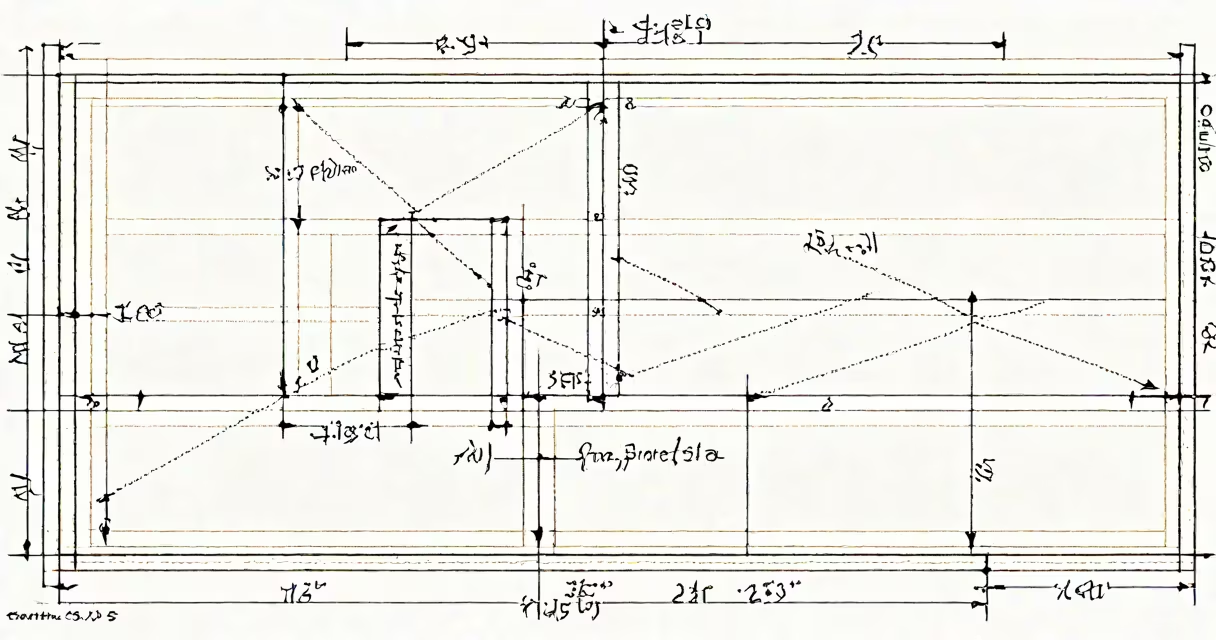
The formula for perimeter of a rectangle is P = 2(l + w), where P is the perimeter, l is the length, and w is the width. This calculation measures the total distance around the outside of a rectangle.
To find the perimeter, you add up the lengths of all four sides. Since opposite sides of a rectangle are equal, you can simplify this to 2 times the sum of the length and width. For example, a rectangle with length 5 units and width 3 units has a perimeter of 2(5 + 3) = 16 units.
Rectangles come in various forms, but the perimeter formula applies to all of them:
| Type | Description | Example |
|---|---|---|
| Square | A rectangle with all sides equal | P = 2(4 + 4) = 16 units |
| Golden rectangle | A rectangle whose side lengths are in the golden ratio (1:1.618) | P = 2(5 + 8.09) ≈ 26.18 units |
| Oblong rectangle | A rectangle with unequal sides | P = 2(3 + 7) = 20 units |
Many people confuse perimeter with area. While perimeter measures the distance around the rectangle, area measures the space inside the rectangle using the formula A = l × w. For example, a rectangle with length 4 units and width 2 units has a perimeter of 12 units but an area of 8 square units.
Another mistake is assuming all rectangles have equal sides. Only squares-a specific type of rectangle-have all sides equal. Most rectangles have two pairs of equal sides.
The formula for perimeter of a rectangle is useful in many practical situations. For instance, if you're building a fence around a rectangular garden with length 10 meters and width 6 meters, you'd need 2(10 + 6) = 32 meters of fencing. Similarly, knowing the perimeter helps in estimating the amount of material needed for picture frames, room moldings, and more.
When I helped a friend install baseboards in their living room, we used the perimeter formula to calculate how much trim was needed. We measured the room's length and width, applied the formula, and ordered the exact amount required-saving both time and money.
Understanding the perimeter formula is foundational for more advanced geometry concepts. It's a simple yet useful tool for solving real-world problems involving rectangular shapes.