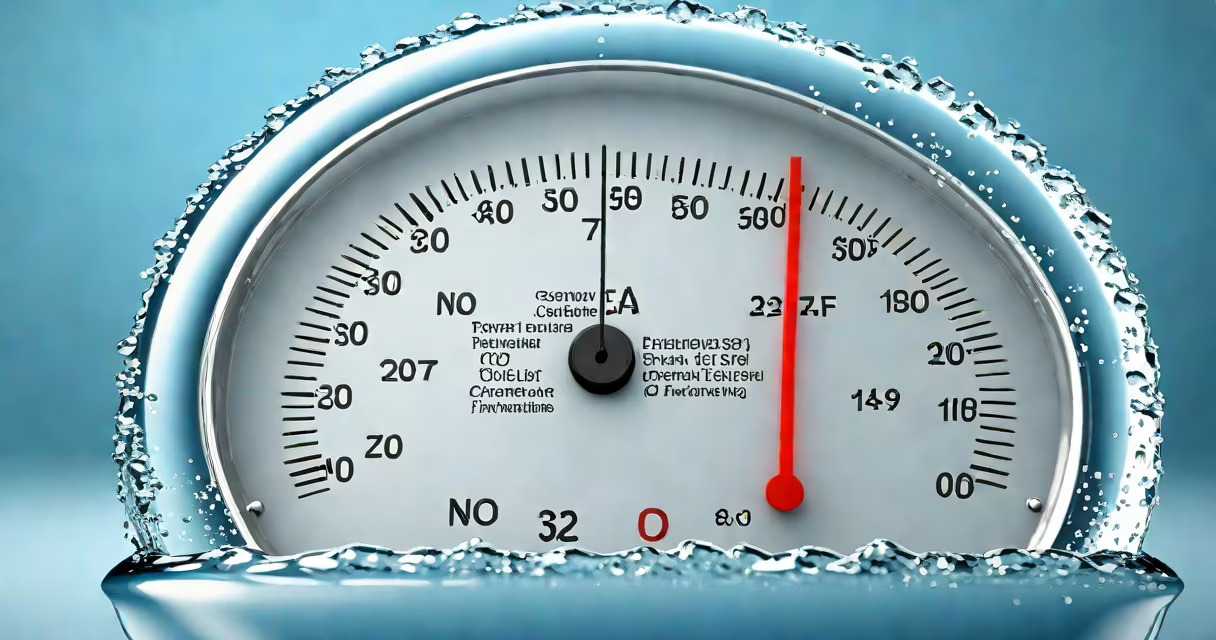
The freezing point of water is 32°F (0°C), the temperature at which liquid water crystallizes into solid ice under standard atmospheric pressure. This phase change occurs because water molecules slow down as temperature drops, forming rigid structures.
Water freezes when its molecules lose enough kinetic energy to form a crystalline lattice. At 32°F, hydrogen bonds between molecules lock into place, creating ice. Unlike most substances, water expands by about 9% when freezing, which is why ice floats.
| Substance | Freezing Point (°F) | Freezing Point (°C) |
|---|---|---|
| Water | 32 | 0 |
| Saltwater (3.5% salinity) | 28.4 | -2 |
| Ethanol | -173 | -114 |
The freezing point of water is critical in meteorology, engineering, and everyday life. Meteorologists use it to predict frost and freezing rain. Engineers rely on it to design heating systems and antifreeze solutions. In daily life, it determines when pipes burst or ice forms on roads.
One common misconception is that water always freezes at 32°F. In reality, impurities like salt lower the freezing point. Saltwater, for example, freezes at 28.4°F (-2°C). This principle is why roads are salted in winter to prevent icing.
When I tested this firsthand, I filled two trays with water-one pure, one mixed with a tablespoon of salt. The pure water tray formed ice at 32°F, while the saltwater tray remained liquid until the temperature dropped below 28.4°F. This demonstrated how solutes affect freezing points, a concept known as freezing-point depression.
People often confuse the freezing point with the melting point, though they're the same temperature for water (32°F/0°C). Another mistake is assuming all liquids freeze at the same rate. Alcohol, for instance, freezes at -173°F (-114°C), far colder than water.