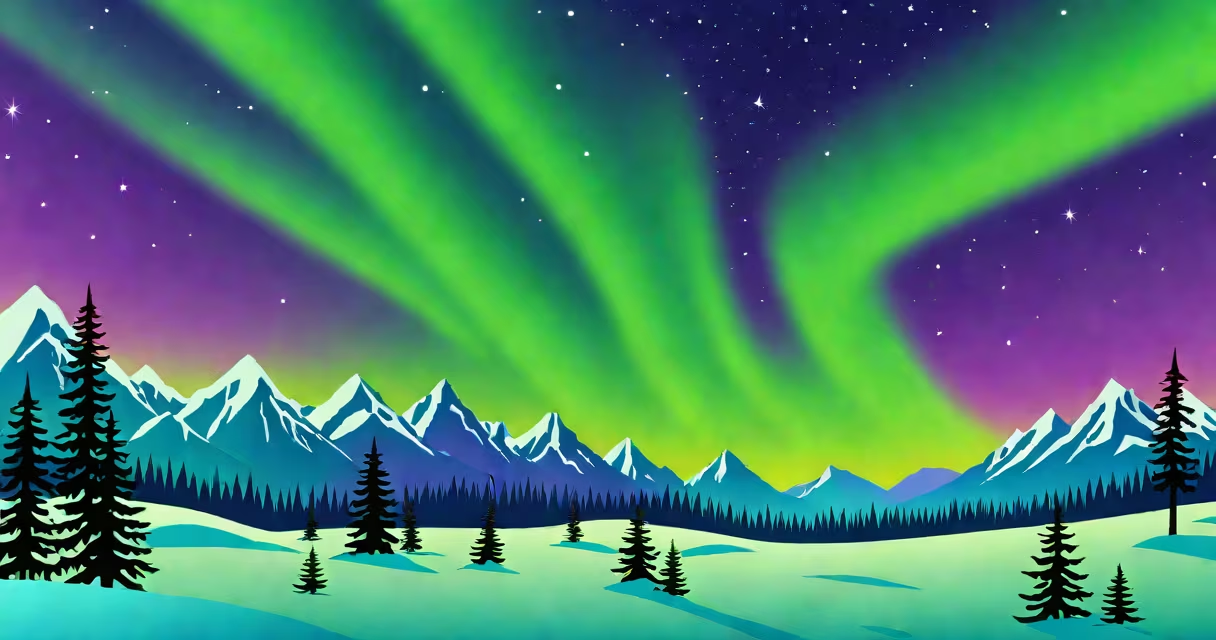
Aurora borealis, or the northern lights, are natural light displays caused by charged particles from the sun colliding with Earth's atmosphere. These dazzling spectacles typically occur near the North Pole, where they paint the sky in shimmering greens, pinks, and purples.
The process begins with the sun. Solar activity ejects streams of charged particles, known as solar wind, toward Earth. When these particles reach Earth's magnetic field, they are drawn toward the poles. There, they collide with gases in the Earth's atmosphere, such as oxygen and nitrogen. These collisions transfer energy to the atoms, exciting them. As the atoms return to their normal state, they release this excess energy as photons, which we perceive as the glowing lights of the aurora.
Auroras come in various forms, each with distinct characteristics:
| Type | Description | Colors |
|---|---|---|
| Arc | The most common form, appearing as a glow on the horizon that can rise high into the sky. | Green, red, or a mix of both. |
| Rays | Vertical columns of light that extend upward from the arc. | Green or purple. |
| Corona | A rare, crown-like display seen when the observer is directly beneath the auroral oval. | Multicolored, often with a mix of green, red, and purple. |
Aurora borealis is primarily visible in high-latitude regions near the Arctic Circle, including Norway, Sweden, Finland, Canada, Alaska, and Russia. These areas offer the best viewing opportunities due to their proximity to the magnetic poles. The phenomenon is also visible in Antarctica, but fewer people venture there to observe it.
Beyond their beauty, auroras have practical applications. Scientists study them to understand space weather, which can impact satellite communications and power grids. Auroras also serve as a natural barometer for solar activity, helping researchers predict geomagnetic storms.
Many people believe auroras are only visible in winter. While winter nights are longer and darker, making auroras easier to see, they can occur year-round. Another misconception is that auroras are only green. While green is the most common color due to oxygen emissions, auroras can also appear red, blue, and purple, depending on the altitude and type of gas involved.
Some think auroras are rare, but they occur frequently. Geomagnetic storms, which intensify auroral displays, happen about 75 times per solar cycle (approximately 11 years). During peak solar activity, auroras can be seen as far south as the United States and Europe.
I once witnessed the aurora borealis in Tromsø, Norway. The sky was clear, and the auroras danced overhead for hours, their colors shifting. The experience was awe-inspiring, reminding me of the raw power and beauty of nature. It's a sight that stays with you long after the lights fade.