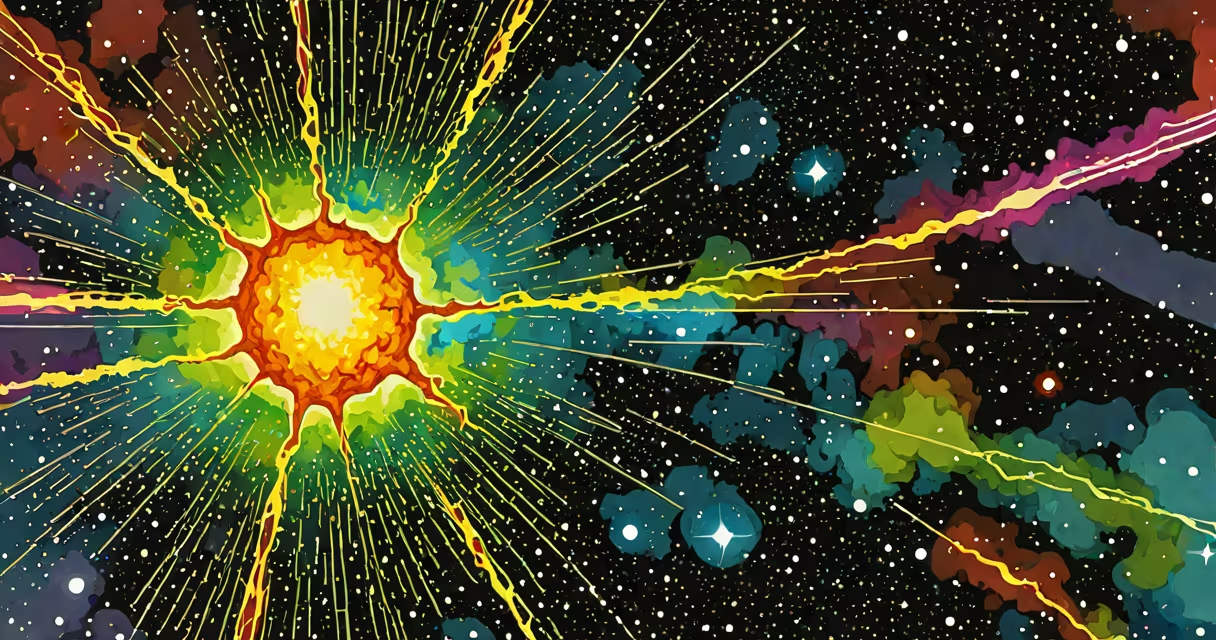
The gamma ray band is the highest-energy segment of the electromagnetic spectrum, spanning wavelengths from 0.01 nanometers to 0.0001 nanometers. These rays originate from extreme cosmic events like supernovae and neutron star collisions.
Gamma rays form when subatomic particles like protons and electrons collide at near-light speeds. This releases energy as photons, which travel in straight lines until they encounter matter. Unlike visible light, gamma rays penetrate deeply but deposit their energy suddenly, making them dangerous to living tissue.
Most gamma rays come from space. The two primary types are:
On Earth, gamma rays occur naturally from radioactive elements like uranium and radon. Human-made sources include medical imaging devices and nuclear power plants.
Scientists study gamma rays to understand extreme cosmic events. NASA's Fermi Gamma-ray Space Telescope maps the sky for bursts, while ground-based observatories like the High-Altitude Water Cherenkov (HAWC) Observatory detect high-energy particles.
Medically, gamma rays sterilize equipment and treat cancer through targeted radiation therapy. However, prolonged exposure causes radiation sickness and increases cancer risk.
Many confuse gamma rays with X-rays, but gamma rays have shorter wavelengths and higher energy. Unlike X-rays, which hospitals produce artificially, gamma rays typically originate from natural processes.
Another myth is that gamma rays always cause immediate harm. In reality, brief exposures from medical procedures pose minimal risk when properly controlled.
In 2022, astronomers detected GRB 221009A, the brightest gamma-ray burst ever recorded. Lasting over 10 hours, this event released energy equivalent to a billion suns shining for a day. The burst likely came from a collapsing massive star in a distant galaxy, offering clues about early universe star formation.