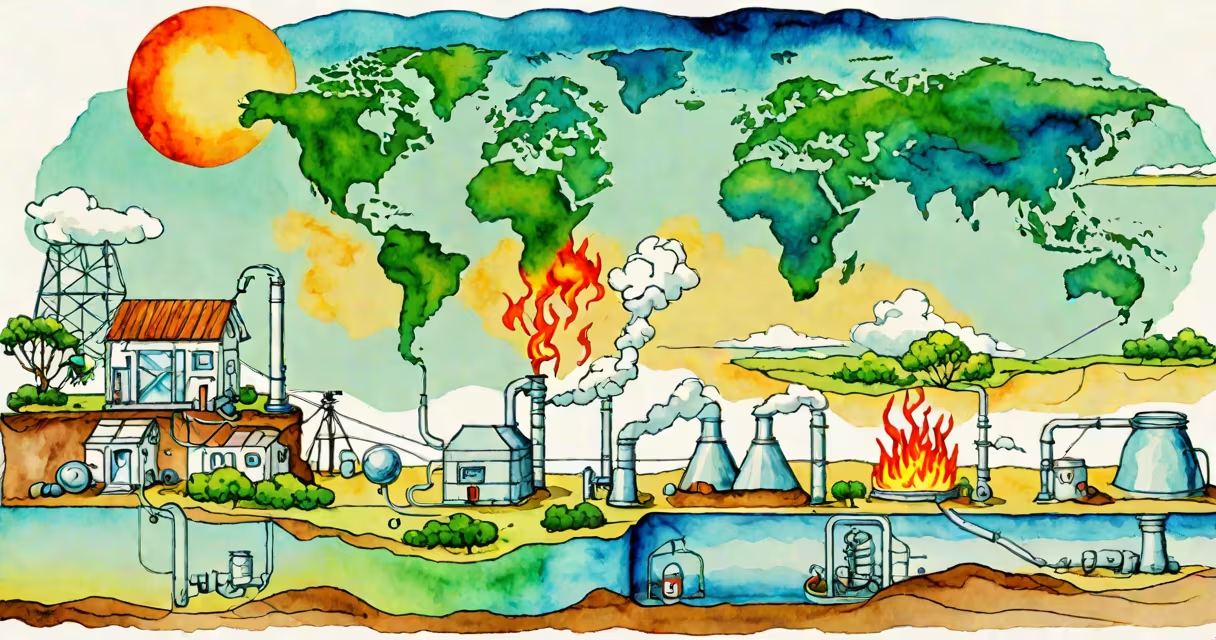
Greenhouse gases are atmospheric gases that absorb and emit radiation, warming the Earth's surface. The primary greenhouse gases are carbon dioxide, methane, nitrous oxide, and fluorinated gases.
These gases form a "blanket" around the Earth, allowing sunlight to enter but trapping some of the outgoing infrared radiation. This natural process keeps the planet warm enough for life, but human activities have increased concentrations, enhancing the effect.
| Gas | Source | Atmospheric Lifetime | Global Warming Potential (100-year) |
|---|---|---|---|
| Carbon Dioxide (CO₂) | Burning fossil fuels, deforestation | Centuries to millennia | 1 |
| Methane (CH₄) | Livestock, landfills, natural gas systems | 12 years | 28-36 |
| Nitrous Oxide (N₂O) | Agricultural activities, industrial processes | 114 years | 265-298 |
| Fluorinated Gases | Industrial applications, refrigeration | Thousands of years | 4,000-9,000 |
The largest source of greenhouse gas emissions is the burning of fossil fuels for electricity, heat, and transportation. Other significant sources include agriculture, deforestation, and industrial processes.
For example, a single cow can produce about 220 pounds of methane per year through belching and manure. With over 1 billion cattle globally, this contributes to methane levels.
Many people confuse greenhouse gases with ozone-depleting substances like chlorofluorocarbons (CFCs). While both affect the atmosphere, they do so in different ways. Greenhouse gases warm the planet, whereas CFCs deplete the ozone layer.
To mitigate climate change, efforts focus on reducing emissions through renewable energy, energy efficiency, reforestation, and sustainable agriculture. For instance, switching power can cut carbon dioxide emissions.
I've seen firsthand how solar panels on homes reduce reliance on fossil fuels. A typical residential solar system can offset about 3 to 4 tons of CO₂ annually, equivalent to planting over 100 trees each year.
Understanding greenhouse gases is important for addressing climate change. By recognizing their sources and impacts, we can take steps to reduce emissions and protect the environment.