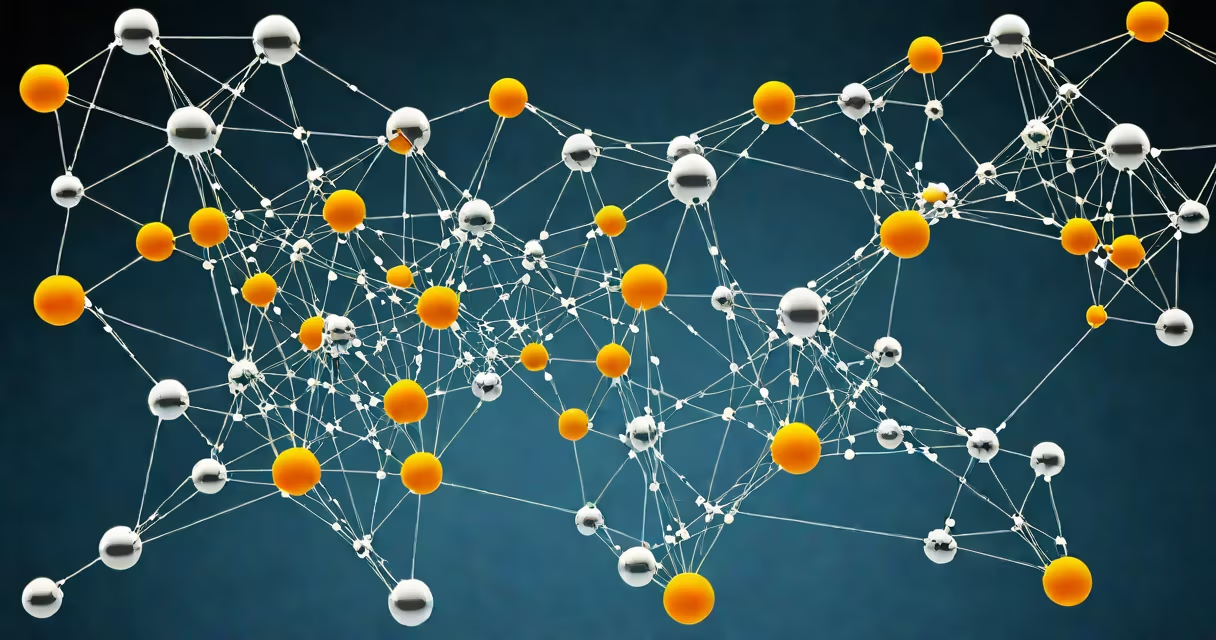
Graph machine learning applies machine learning algorithms to data represented as graphs, where relationships between entities are as important as the entities themselves. This approach excels at modeling complex systems like social networks, molecular structures, and recommendation engines.
Graph machine learning operates on graph-structured data, which consists of nodes (entities) connected by edges (relationships). Unlike traditional machine learning methods that rely on tabular data, graph-based algorithms consider both node features and their connections. For example, predicting protein interactions requires analyzing both the properties of individual proteins and how they interact with others.
These algorithms typically fall into three categories:
| Algorithm Type | Key Characteristics | Example Application |
|---|---|---|
| Graph Neural Networks (GNNs) | Use message-passing frameworks to aggregate neighbor information | Drug discovery by analyzing molecular interaction graphs |
| Random Walks | Simulate paths through the graph to capture structural patterns | Community detection in social networks |
| Graph Kernels | Measure similarity between graphs using predefined substructures | Protein structure analysis |
Graph Neural Networks (GNNs) have gained significant attention due to their ability to learn representations of nodes and edges simultaneously. These models use techniques like spectral graph theory and spatial graph convolutions to process graph-structured data effectively. For instance, the Graph Convolutional Network (GCN) aggregates feature information from neighboring nodes through multiple layers, enabling it to capture complex patterns in the data.
Graph machine learning finds applications in diverse domains where relationships between entities play a important role. In social network analysis, it helps identify communities, detect anomalies, and recommend connections. In biology, it aids in understanding protein interactions and predicting drug effects. In cybersecurity, it detects intrusions by analyzing network traffic patterns.
One notable application is in recommendation systems. Traditional collaborative filtering methods often struggle with cold-start problems, where new users or items lack sufficient interaction history. Graph-based approaches can use auxiliary information, such as user preferences and item attributes, to make accurate recommendations even with limited data.
Another misconception is that graph machine learning is only suitable for large-scale datasets. In reality, it can be applied to small and medium-sized graphs as well. The key advantage lies in its ability to capture complex relationships, regardless of the dataset size. For example, even in small molecular datasets, graph-based algorithms can reveal meaningful patterns that other methods might miss.
Financial institutions use graph machine learning to detect fraudulent activities by analyzing transaction networks. Each transaction is represented as a node, and edges connect transactions involving the same account or entity. By applying graph-based algorithms, banks can identify suspicious patterns, such as sudden spikes in transaction volumes or unusual connections between accounts.
For instance, a bank might use a Graph Neural Network to analyze its transaction data. The model would aggregate information from neighboring transactions, highlighting anomalies that indicate potential fraud. This approach has proven to be more effective than traditional methods, which often rely on simple rule-based systems.
Graph machine learning represents a useful tool for analyzing complex systems where relationships between entities are critical. By using graph-structured data, it enables more accurate predictions and insights across various domains. As the field continues to evolve, we can expect even more new applications and improvements in performance.