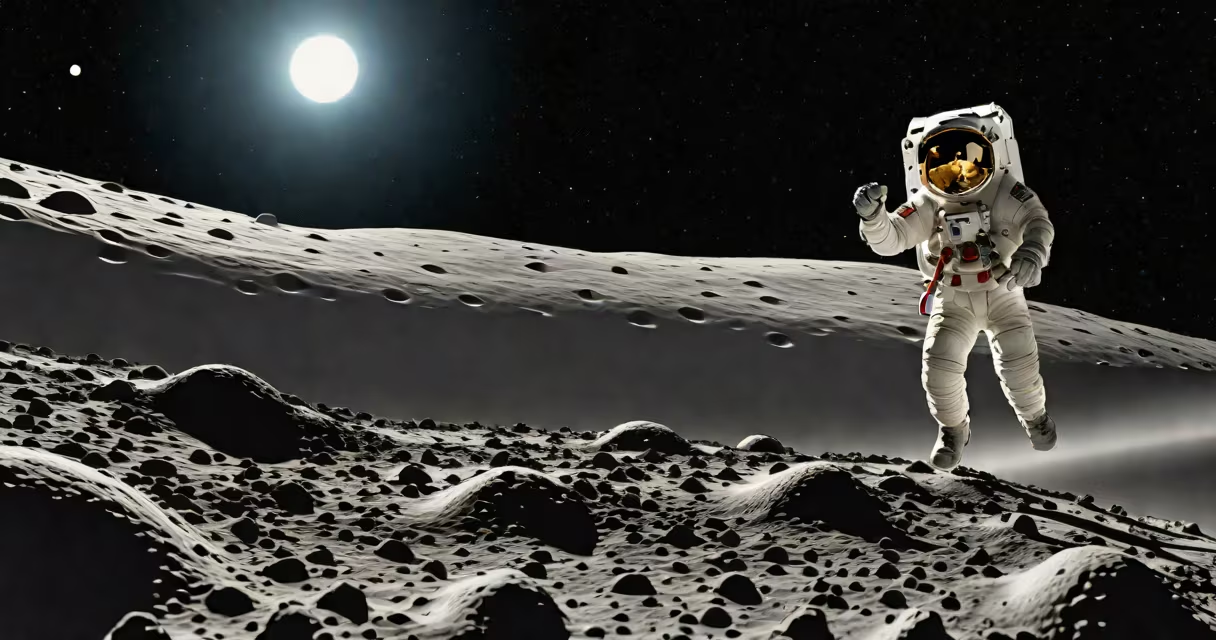
Gravity on the moon is about 16.5% of Earth's, meaning a 200-pound person would weigh just 33 pounds there. This weaker gravitational pull creates the iconic slow-motion movements seen in Apollo mission footage.
The moon's smaller mass (about 81 times less than Earth's) and lower density result in weaker gravity. Unlike Earth's 9.8 m/s², the moon's surface gravity is only 1.62 m/s². This difference affects everything from how astronauts move to how objects fall.
| Effect | Description | Example |
|---|---|---|
| Reduced Weight | Objects and people weigh much less | A 100 kg object on Earth weighs just 16.5 kg on the moon |
| Slower Freefall | Objects fall more slowly | Dropping a hammer would take longer to hit the ground |
| Lower Escape Velocity | Less speed needed to leave orbit | 2.4 km/s vs. Earth's 11.2 km/s |
Weaker gravity presents challenges for long-term habitation. Astronauts experience muscle atrophy and bone loss due to reduced gravitational forces. Future moon bases may need artificial gravity solutions. The lower escape velocity also makes launching from the moon easier, which could support future missions to Mars.
One common misconception is that the moon has no gravity. In reality, it has about 1/6th of Earth's gravity. Another mistake is assuming objects float freely on the moon's surface - they still fall, just more slowly.
During the Apollo 15 mission, astronaut David Scott dropped a feather and a hammer simultaneously. Both hit the ground at the same time, demonstrating Galileo's theory of gravitational acceleration in a vacuum. This wouldn't happen on Earth due to air resistance.
Understanding lunar gravity is important for planning future missions. As we prepare to return to the moon, scientists continue studying its gravitational effects to develop better technologies and safety protocols for astronauts.