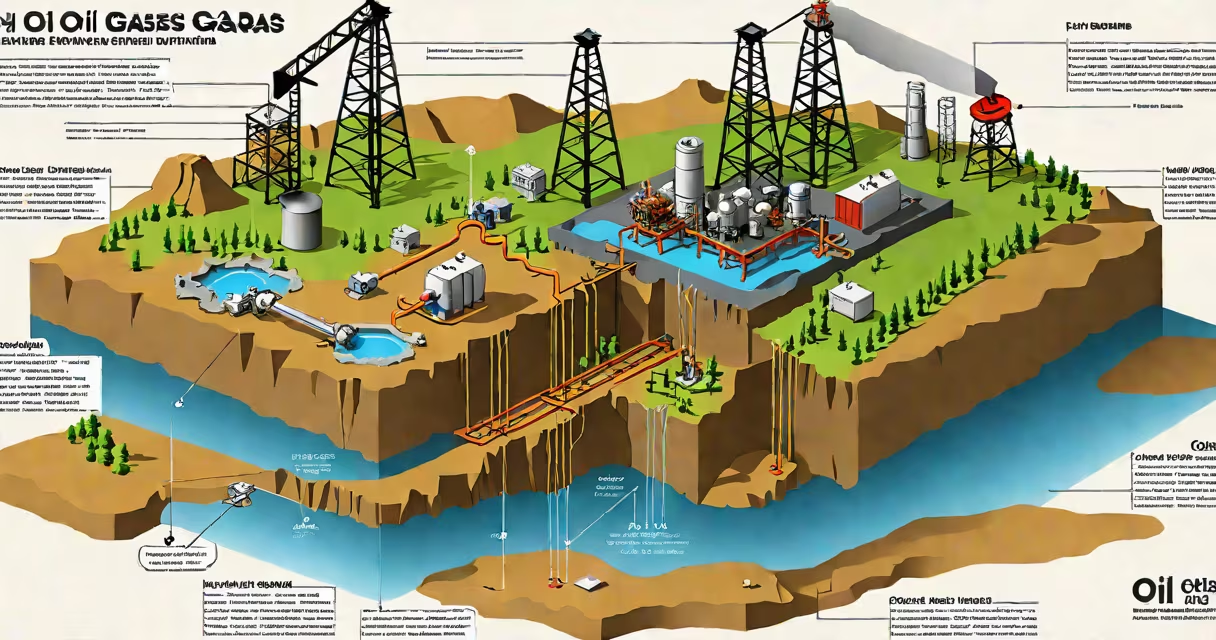
Oil and gas form from the remains of ancient marine organisms buried under layers of sediment, transformed by heat and pressure over millions of years. This process, called catagenesis, converts organic material into hydrocarbons.
The formation of oil and gas begins with microscopic plants and animals that live in oceans and lakes. When these organisms die, their bodies settle on the seafloor or lakebed, mixing with sediments like sand and silt. Over time, layers of sediment build up, burying the organic material.
As the sediment layers accumulate, they create intense pressure and heat, which transforms the organic material into a waxy substance called kerogen. Further heating breaks down kerogen into liquid hydrocarbons (oil) and gaseous hydrocarbons (natural gas). This process occurs at depths of 1.5 to 3 miles below the Earth's surface and temperatures between 90°C and 160°C (194°F and 320°F).
Oil and gas are composed of different hydrocarbons, which are molecules made of hydrogen and carbon atoms. The main types of hydrocarbons found in oil and gas include:
Oil and gas are primarily used as energy sources. Oil is refined into gasoline, diesel fuel, jet fuel, heating oil, and other petroleum products. Natural gas is used for heating, cooking, electricity generation, and as a fuel for vehicles., oil and gas are used as raw materials in the production of chemicals, plastics, and other materials.
Oil and gas are found in sedimentary basins around the world. These basins are formed by the movement of tectonic plates, which creates areas where sediments can accumulate. The most significant oil and gas reserves are found in the Middle East, Russia, the United States, China, and other regions with extensive sedimentary basins.
One common misconception is that oil and gas are formed from the remains of dinosaurs. While it is true that some organic material contributes to the formation of oil and gas, the primary sources are microscopic plants and animals that lived millions of years ago. Dinosaur remains are not a significant contributor to oil and gas formation.
Another misconception is that oil and gas are formed quickly. In reality, the process takes millions of years, involving the burial of organic material, the application of heat and pressure, and the transformation of kerogen into hydrocarbons.
For example, the Ithaca oil field in Texas is a significant source of oil and gas. The oil and gas in this field were formed from the remains of ancient marine organisms that were buried under layers of sediment. Over millions of years, the heat and pressure transformed the organic material into oil and gas, which is now extracted and used as an energy source.
Oil and gas are formed from the remains of ancient marine organisms that are buried under layers of sediment and transformed by heat and pressure over millions of years. These hydrocarbons are used as energy sources and as raw materials in the production of chemicals and plastics. Understanding how oil and gas are formed is essential for the exploration and production of these valuable resources.