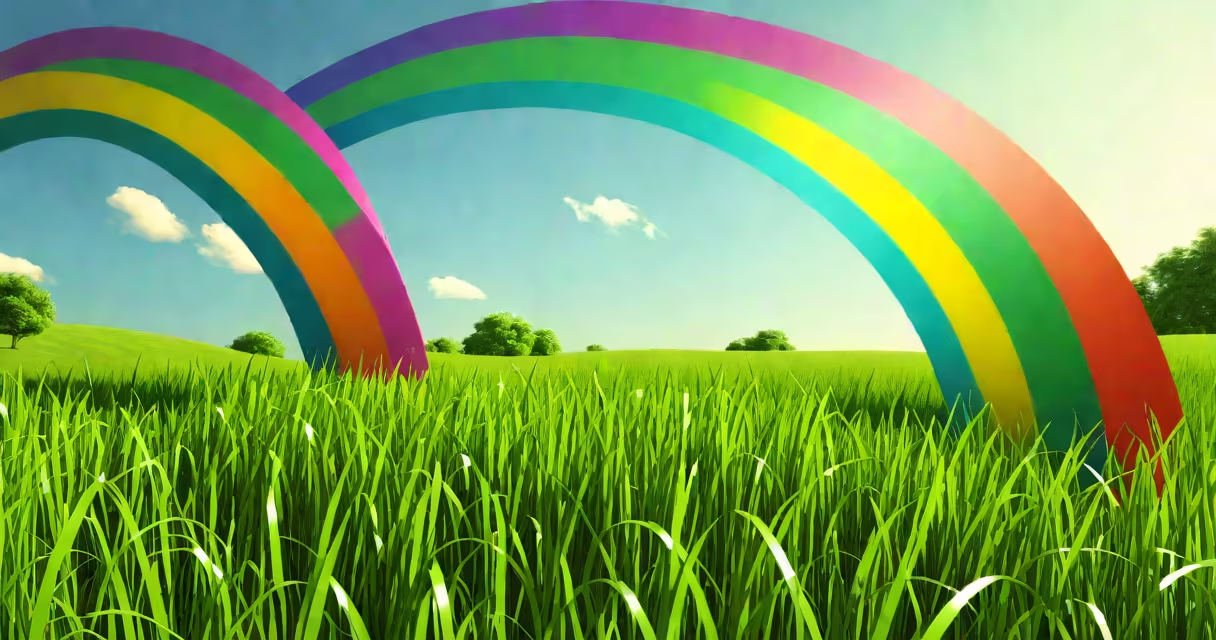
A rainbow contains seven traditional colors: red, orange, yellow, green, blue, indigo, and violet. This sequence is often remembered by the acronym ROYGBIV.
The seven-color division comes from Isaac Newton, who assigned specific color names to different wavelength ranges in white light's spectrum. He chose seven because he associated colors with musical notes, favoring symmetry over strict physics.
Newton's original rainbow actually had five colors (red, orange, yellow, blue, violet) until he expanded it to seven in later writings. The inclusion of indigo and green was somewhat arbitrary, as these colors blend together in a natural rainbow.
Rainbows appear when sunlight refracts through water droplets, splitting into component wavelengths we perceive as colors. Each color corresponds to a different light wavelength:
These ranges overlap, meaning a rainbow shows continuous color variation rather than distinct bands.
Modern spectroscopy reveals rainbows contain all colors of visible light (about 10 million distinguishable shades), not just seven. The human eye blends nearby colors due to limitations in cone cell sensitivity. For example, cyan appears between blue and green wavelengths despite not being in Newton's original list.
Some cultures recognize fewer or additional colors. The Irish traditionally saw just five rainbow colors, while modern color science identifies at least 11 distinct bands in ideal conditions.
Secondary rainbows (outer arcs) show reversed color order due to double light internal reflection. These often appear dimmer with wider bands. Tertiary and quaternary rainbows exist but are extremely rare and usually monochromatic.
Supernumerary rainbows-faint, closely spaced bands inside primary arcs-occur from wave interference effects. These create extra greenish and bluish fringes between main color divisions.
Many assume rainbows form from pure color separation, but they're actually continuous spectra. The distinct bands we see result from how our eyes and brains process color information, not physical gaps in the light.
Another myth is that rainbows always appear as full circles. From ground level, we typically see just the upper portion (about 42° radius). Aerial observers can sometimes view complete circular rainbows.
Using high-resolution spectrometers, researchers have measured over 30 distinct color bands in laboratory-generated rainbows. Natural atmospheric conditions usually produce 7-11 visibly distinct colors due to air density variations and droplet size differences.
In Hawaiian culture, rainbows (ʻanuenue) symbolize transformation and connection between earthly and spiritual realms. The Maori of New Zealand consider rainbows (āniwaniwa) as bridges between the physical and ancestral worlds.