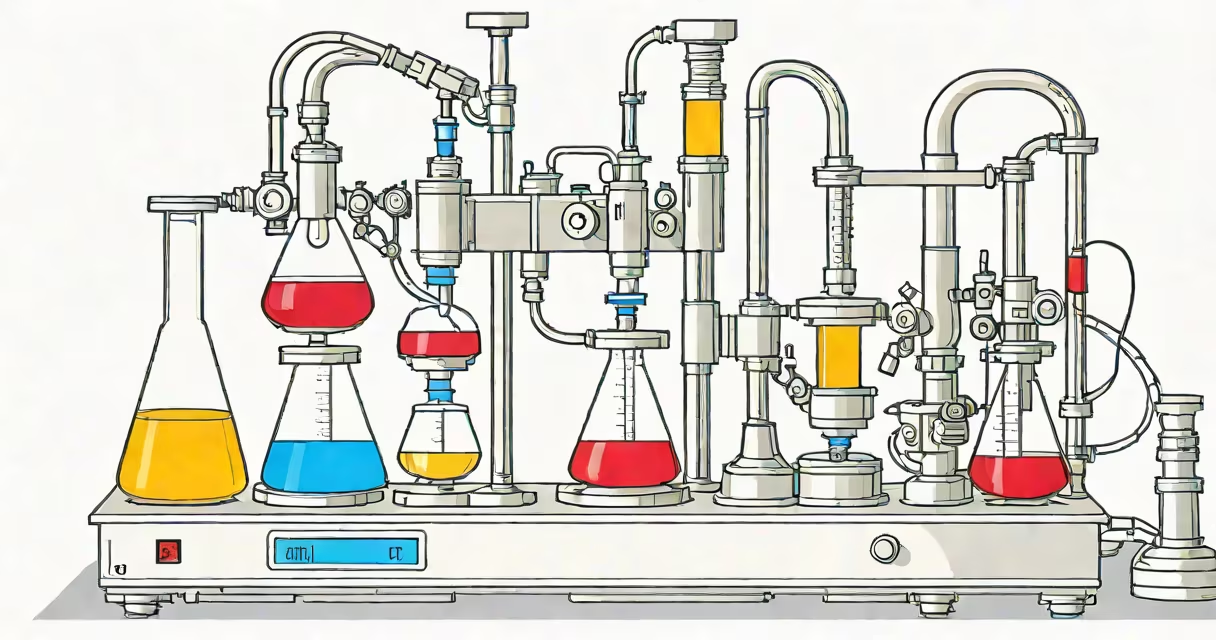
Isothermal titration calorimetry (ITC) is a biophysical technique that measures heat exchange during molecular interactions, quantifying binding affinities and reaction kinetics. The method works by injecting small volumes of one reactant into a solution containing another while maintaining constant temperature. A sensitive calorimeter detects the resulting heat changes, which reflect the thermodynamic properties of the interaction.
ITC instruments contain a sample cell holding one reactant and a syringe delivering the other. As titrant is injected, the system releases or absorbs heat depending on whether the interaction is exothermic or endothermic. The calorimeter measures these minute temperature changes, converting them into power (heat per unit time) and integrating the data over time to yield enthalpy changes (ΔH). Software then fits the raw data to a binding model, extracting parameters like association constant (KA), stoichiometry (n), and entropy change (ΔS).
The core components include:
Most modern ITC instruments use power-compensation or heat-balance designs. Power-compensation systems actively adjust heating to maintain temperature, while heat-balance systems measure heat flow between the cell and a reference vessel.
Researchers primarily use ITC in biochemistry, pharmacology, and materials science to study:
Unlike other methods, ITC requires no labels or immobilizations, providing direct measurement of all binding parameters in a single experiment. This makes it ideal for characterizing complex interactions like multivalent binding or allosteric regulation.
Many assume ITC only works for high-affinity interactions (KA > 105 M-1). However, specialized protocols now extend its range to weaker binders (KA ~ 103 M-1). Another misconception is that ITC requires large sample quantities. While traditional ITC uses milligrams of material, microcalorimetry variants reduce this to micrograms.
Firsthand experience: When analyzing a weak protein-protein interaction, we initially struggled with data interpretation. By adjusting the injection protocol to include a pre-equilibrium step, we resolved the issue and obtained clear binding isotherms. This highlighted how critical proper experimental design is for successful ITC measurements.
| Method | Label-Free | Direct Measurement | Multiple Parameters | Sample Requirements |
|---|---|---|---|---|
| ITC | Yes | td>YesYes (ΔH, ΔS, KA, n) | Milligrams | |
| Surface Plasmon Resonance (SPR) | Yes | No (indirect via refractive index) | No (only KA) | Micrograms |
| Isothermal Microcalorimetry | Yes | Yes | Partial (ΔH only) | Micrograms |
| Fluorescence Polarization | No | No | No | Nanograms |
Isothermal titration calorimetry provides unique insight into molecular interactions by directly measuring their thermodynamic signatures. Its ability to quantify all binding parameters in a single experiment makes it indispensable for understanding complex biological systems at the molecular level.