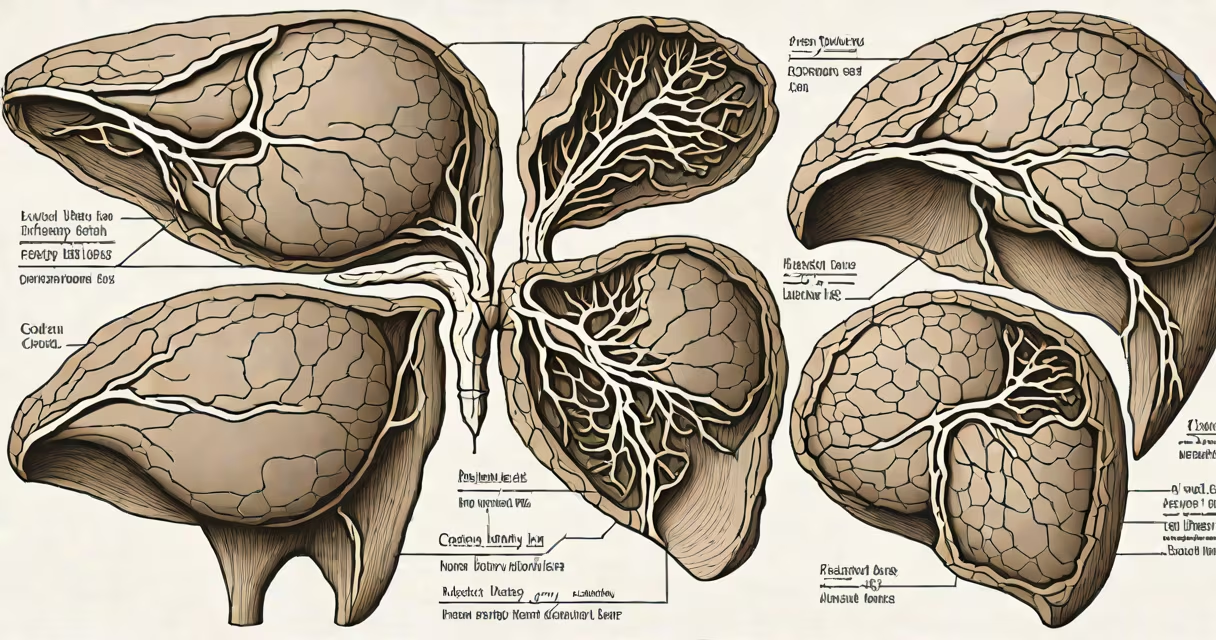
Liver segment anatomy divides the liver into eight distinct sections based on blood supply and function. This system helps surgeons plan resections and doctors assess diseases like cancer.
The liver divides into two main lobes: the larger right lobe and smaller left lobe. Each lobe further divides into four sections (segments). The portal vein branches supply blood to each segment, creating independent units.
This segmentation follows Couinaud's classification, the standard system since 1957. Each segment has its own blood supply, bile drainage, and lymphatic flow, making them functionally independent.
| Segment Number | Location | Size |
|---|---|---|
| I | Caudate lobe | Smallest |
| II | Left lobe upper division | Medium |
| III | Left lobe lower division | Medium |
| IV | Quadrate lobe | Medium |
| V | Right lobe anterior superior | Large |
| VI | Right lobe anterior inferior | Large |
| VII | Right lobe posterior superior | Large |
| VIII | Right lobe posterior inferior | Large |
Doctors use liver segment anatomy to plan surgeries like tumor removals. Since each segment has independent blood flow, surgeons can remove diseased parts while preserving healthy tissue. This is important for liver cancer patients who may need multiple surgeries.
For example, a surgeon might remove segment VII while keeping adjacent segment VIII intact. This preserves enough healthy liver tissue for recovery. The liver's ability to regenerate makes this possible.
Many people confuse liver segments with liver lobes. While the liver has two main lobes, each lobe contains multiple segments. Another mistake is assuming all segments are equal in size-the right lobe segments are larger than left lobe segments.
Some also believe the liver is just one large organ without distinct sections. In reality, its segmented structure allows for precise surgical interventions and targeted treatments.
During my rotation in hepatobiliary surgery, I observed how surgeons use this segmentation system. For a patient with a tumor in segment VI, the surgical team planned a partial hepatectomy to remove only that segment. This preserved the remaining seven segments, allowing the liver to maintain its essential functions like albumin production and detoxification.
Post-surgery, the patient's liver regenerated the removed segment within weeks. This demonstrates the practical importance of understanding liver segment anatomy for successful outcomes.