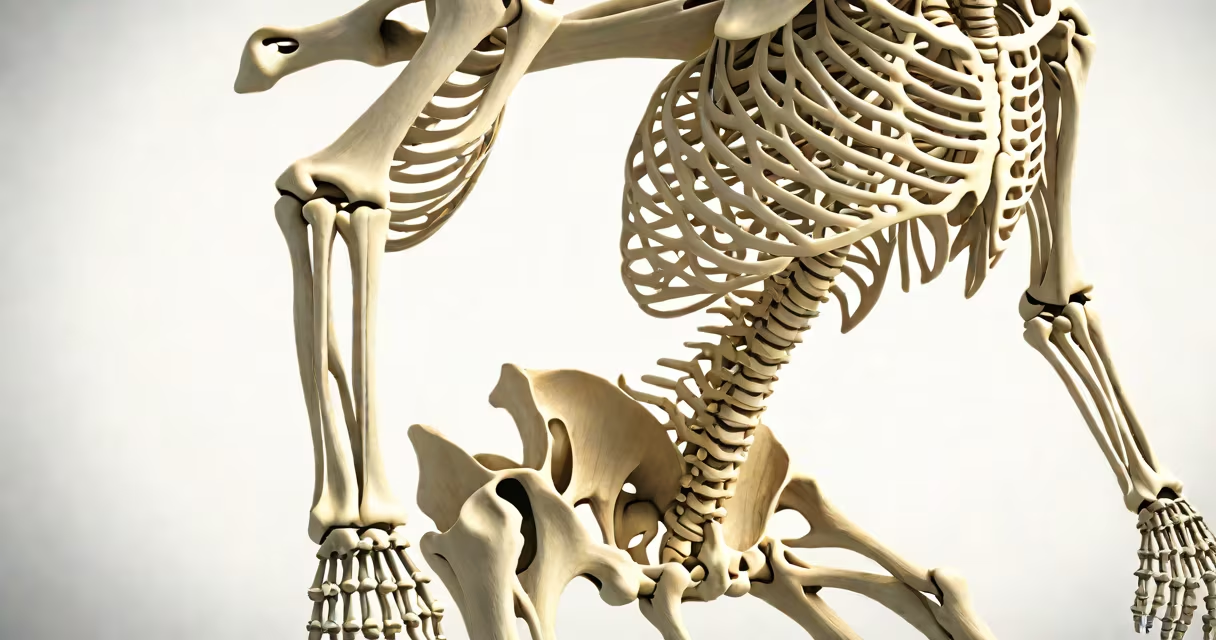
Long bones are hard, dense bones that support weight and help movement, primarily found in the limbs. These bones are longer than they are wide, with a shaft and rounded ends.
Long bones consist of a cylindrical shaft called the diaphysis and rounded ends called epiphyses. The diaphysis contains yellow marrow, which stores fat, while the epiphyses contain red marrow, which produces blood cells. The periosteum, a tough membrane, covers the bone surface, providing structure and attachment points for tendons and ligaments.
Long bones can be categorized based on their location and function:
| Type | Examples | Function |
|---|---|---|
| Upper Limb Long Bones | Humerus, radius, ulna | Support and movement of the arms |
| Lower Limb Long Bones | Femur, tibia, fibula | Support and movement of the legs |
Long bones are important for movement and support. For example, the femur, the longest and strongest bone in the body, supports the weight of the upper body and facilitates walking, running, and jumping. The humerus, located in the upper arm, allows for many movements, including lifting and rotating the arm.
Many people confuse long bones with other types of bones, such as short bones (like those in the wrists and ankles) or flat bones (like the ribs and sternum). Unlike long bones, these bones have different shapes and functions. For instance, short bones provide stability and support with minimal movement, while flat bones protect organs and provide attachment points for muscles.
Another misconception is that all long bones are the same. While they share similar structures, each long bone has unique features tailored to its specific function. For example, the femur has a larger diameter and thicker cortex compared to the humerus, reflecting its role in bearing more weight.