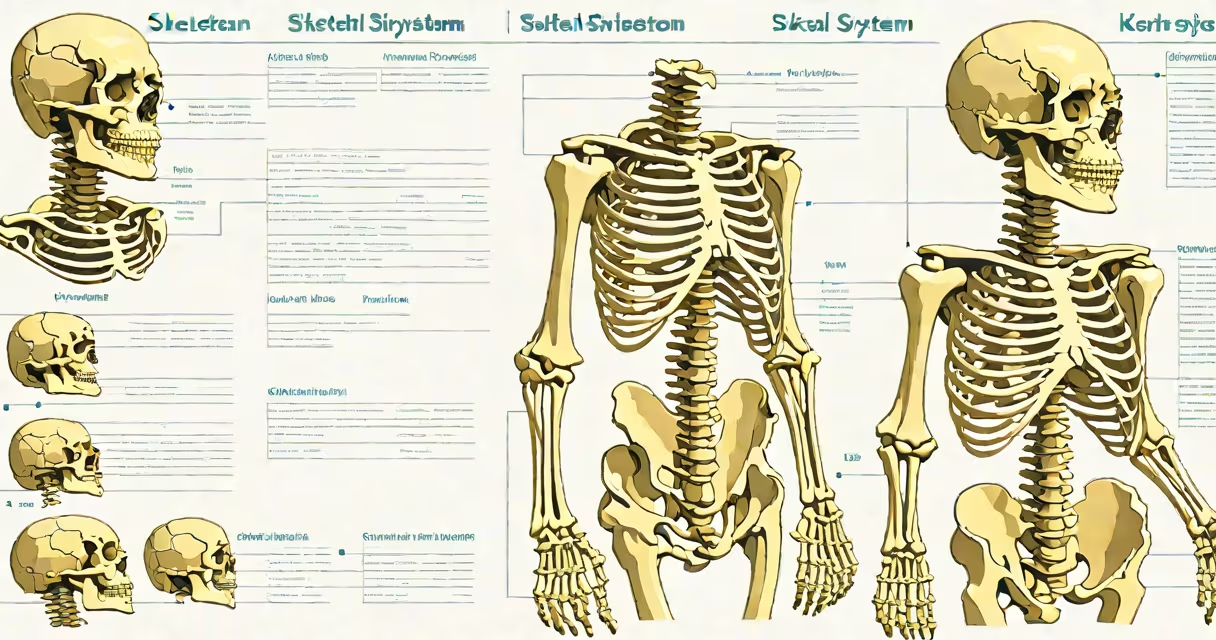
The main structure of the skeletal system consists of bones, cartilage, and joints that provide support, protection, and enable movement. This structure forms the rigid structure of the body, anchoring muscles and other tissues.
The skeletal system comprises over 200 bones, cartilage, and joints. Bones are rigid organs composed mainly of calcium phosphate and collagen fibers. Cartilage, a flexible connective tissue, cushions joints and covers bone surfaces. Joints connect bones, allowing movement through ligaments and tendons.
Bones vary in shape and function:
| Type | Description | Examples |
|---|---|---|
| Long bones | Longer than wide, designed for strength and movement | Femur, humerus |
| Short bones | Cube-shaped, provide stability and support | Wrist and ankle bones |
| Flat bones | Thin and flat, protect organs and provide surface area for muscle attachment | Ribs, sternum, scapula |
| Irregular bones | Complex shapes, fit specific functions | Vertebrae, hip bones |
The skeletal system supports the body, protects internal organs, and enables movement. Bones store minerals like calcium and phosphorus, essential for bodily functions. Bone marrow within bones produces red and white blood cells.
Many believe cartilage is only found in joints. However, it also lines the respiratory tract and ears. Another misconception is that bones are inert. Bones constantly remodel through the balance of osteoblasts and osteoclasts, cells that build and break down bone tissue respectively.