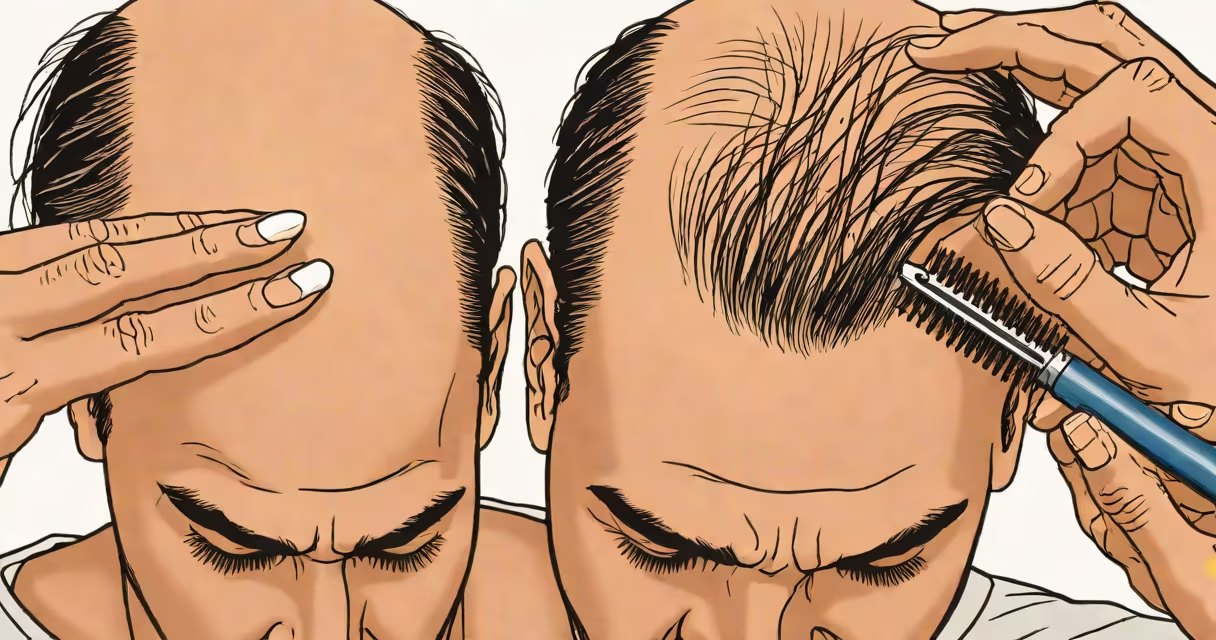
The most effective hair loss treatment for men depends on the cause, but FDA-approved options like minoxidil and finasteride have proven results. These treatments address androgenetic alopecia, the most common form of male hair loss.
Hair loss occurs when hair follicles shrink and stop producing hair. This happens due to genetic factors, aging, or hormonal changes. The most common cause is male pattern baldness, which involves sensitivity to dihydrotestosterone (DHT). Treatments work by either blocking DHT or stimulating hair growth.
| Treatment Type | Mechanism | Effectiveness |
|---|---|---|
| Minoxidil | Vasodilator that stimulates hair follicles | Regrows hair in 30% of men, stops progression in 60% |
| Finasteride | DHT blocker | Stops hair loss in 88%, regrows hair in 66% |
| Dutasteride | More potent DHT blocker | More effective than finasteride but not FDA-approved for hair loss |
| Low-level laser therapy | Stimulates hair growth with light | Moderate effectiveness, often combined with other treatments |
Many people confuse minoxidil and finasteride because both are FDA-approved. However, they work differently. Minoxidil is a topical solution that stimulates hair follicles, while finasteride is an oral medication that blocks DHT. Another common confusion is between finasteride and dutasteride, which are similar but dutasteride is not FDA-approved for hair loss.
John, a 35-year-old man, noticed significant hair thinning. He consulted a dermatologist who diagnosed androgenetic alopecia. The doctor prescribed finasteride, a DHT blocker. After six months, John noticed reduced hair loss and some regrowth. He then added minoxidil to his routine, which further improved his hair density. After a year, John had noticeable improvement in his hair thickness and coverage.
When researching hair loss treatments, I spoke with several men who had tried different options. One man shared that he saw the best results combining finasteride with minoxidil. Another mentioned that low-level laser therapy helped maintain his results but wasn't as effective on its own. These experiences show the importance of consulting with a healthcare provider to determine the most effective treatment plan.
One misconception is that hair loss treatments work immediately. In reality, it can take several months to see results. Another myth is that these treatments are only for older men. In fact, many men start experiencing hair loss in their 20s and can benefit from early intervention., some believe that hair loss treatments are only for severe cases, but they can be effective for mild to moderate hair loss as well.