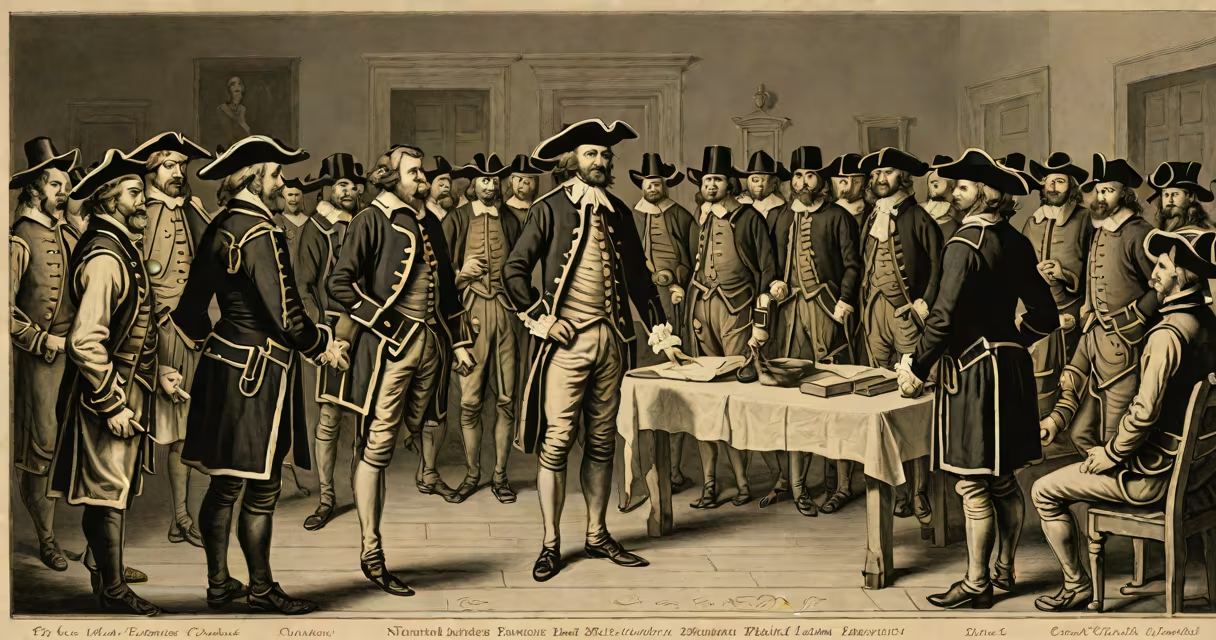
The Nathaniel Bacon rebellion was a 1676 uprising in colonial Virginia led by Nathaniel Bacon against Governor William Berkeley. This revolt exposed deep class tensions between wealthy landowners and poorer settlers, reshaping colonial governance.
The rebellion stemmed from several key issues. Poor settlers resented Berkeley's policies favoring wealthy landowners, including monopolies on trade and land grants. Tensions escalated when Berkeley refused to defend frontier settlements from Native American attacks, forcing settlers to arm themselves.
In 1675, Bacon led an unauthorized military expedition against Native tribes, violating Berkeley's orders. When Berkeley tried to arrest him, Bacon rallied support by portraying himself as a defender of the common people against corrupt elites. The rebellion grew as discontented settlers joined his cause.
The rebellion reached its peak in January 1676 when Bacon's forces captured Jamestown, Virginia's capital. They issued the "Declaration of the People of Virginia," condemning Berkeley's rule and outlining grievances. Berkeley fled to the Eastern Shore, while Bacon established a new government.
However, Bacon died suddenly in October 1676, likely from dysentery. Without his leadership, the rebellion collapsed. Berkeley returned to power, ordering the execution of captured rebels. Though the uprising was short-lived, its impact was profound.
Berkeley was recalled to England to face charges, though he died before standing trial. The rebellion demonstrated the dangers of colonial unrest to British authorities, leading to reforms in colonial governance. These included greater representation for settlers in decision-making and stricter regulations on land distribution.
The Nathaniel Bacon rebellion also marked one of the first instances of interracial cooperation among European settlers, enslaved Africans, and Native Americans against colonial authorities. This alliance challenged racial hierarchies and contributed to long-term shifts in colonial social structures.
One persistent myth is that the rebellion was primarily about slavery. While Bacon did promise freedom to enslaved people who joined his cause, the core issues were economic inequality and political representation. The rebellion's focus was on class rather than race.
Another misconception is that Bacon was a heroic figure fighting for democracy. In reality, he was a controversial leader whose actions were driven by personal ambition as much as by ideals of justice. His tactics included violence and intimidation, complicating his legacy as a champion of the people.
The Nathaniel Bacon rebellion remains a critical case study in understanding colonial resistance and the complexities of early American politics. It highlights how economic disparities and political exclusion can fuel uprisings, even in societies that appear stable on the surface.