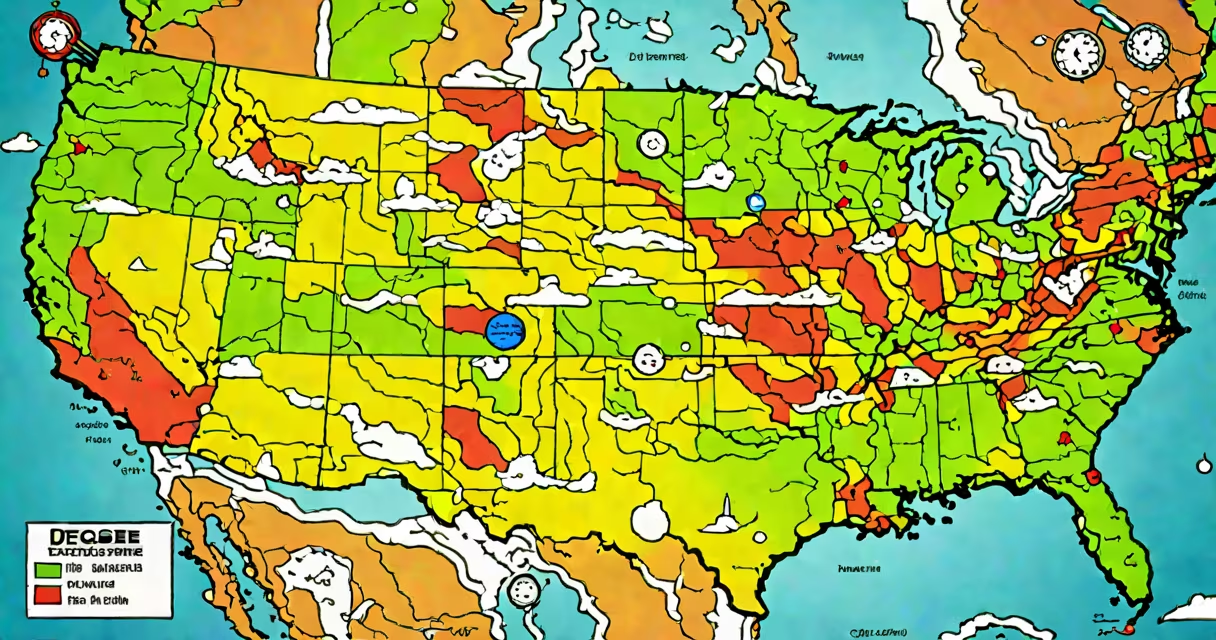
National Degree Day tracks the cumulative number of days when temperatures exceed a certain threshold across the United States. It quantifies extreme heat events nationwide, helping assess climate impacts and energy demands.
The term "degree day" refers to a unit measuring how much a day's average temperature deviates from a standard base temperature (typically 65°F or 18°C). National Degree Day aggregates these measurements across multiple locations to provide a nationwide perspective on extreme heat.
National Degree Day calculations rely on two key metrics: heating degree days (HDD) and cooling degree days (CDD). HDD measures how much a day's average temperature falls below the base temperature, while CDD measures how much it exceeds it. By summing these values over time, meteorologists and climatologists can track patterns of extreme heat or cold across the country.
For example, if the average temperature in New York City is 75°F (24°C) on a given day, the CDD would be 10 (75 - 65). If this pattern continues for several days, the cumulative CDD would reflect the intensity and duration of the heatwave.
| Type | Base Temperature | Purpose |
|---|---|---|
| Heating Degree Days (HDD) | 65°F (18°C) | Measures the need for heating |
| Cooling Degree Days (CDD) | 65°F (18°C) | Measures the need for cooling |
According to the National Oceanic and Atmospheric Administration (NOAA), degree days are important for understanding energy consumption patterns and planning for climate change impacts. For instance, during the 2022 summer heatwaves, National Degree Day calculations helped quantify the severity and duration of extreme heat events across the U.S.
National Degree Day data is used by energy companies, policymakers, and researchers to analyze energy demand, assess climate change impacts, and plan for extreme weather events. For example, utilities use degree day data to predict electricity demand for air conditioning during heatwaves. Policymakers rely on this information to develop strategies for mitigating the effects of extreme heat on public health and infrastructure.
In 2023, the Environmental Protection Agency (EPA) utilized National Degree Day data to evaluate the effectiveness of energy-efficient cooling technologies in reducing the environmental impact of increased air conditioning use during heatwaves.
One common misconception is that National Degree Day only measures extreme heat. However, it also tracks extreme cold by using heating degree days. Another misunderstanding is that degree days are only relevant for energy consumption. In reality, they are also used in agriculture, health studies, and urban planning to assess the impacts of temperature fluctuations.
For instance, farmers use degree day data to monitor growing degree days, which help determine the development stages of crops and pests. Public health officials use this information to predict the spread of temperature-sensitive diseases, such as dengue fever.
I once used degree day data to analyze the energy consumption patterns of a commercial building in Phoenix, Arizona. By comparing the building's energy use with local degree day data, I identified opportunities for improving energy efficiency during peak cooling seasons.
National Degree Day provides a complete measure of extreme heat and cold across the United States, offering valuable insights for energy management, climate research, and public health. By understanding and using this metric, stakeholders can better prepare for and mitigate the impacts of extreme weather events.