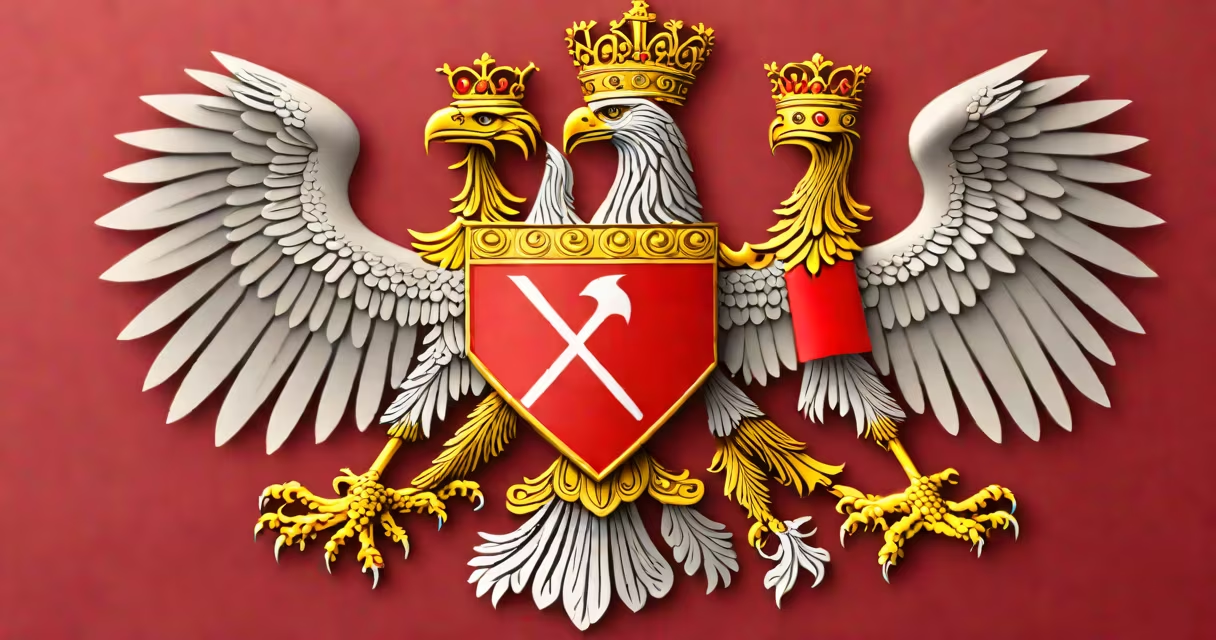
The Polish coat of arms is an official emblem of Poland featuring a white eagle with a golden crown on a red shield. It serves as a national symbol with deep historical roots and legal recognition.
The white eagle motif dates back to the 13th century, appearing on seals and coins of Polish rulers. The earliest known depiction is on a seal from 1295 belonging to Prince Konrad of Masovia. Over time, the design evolved, with the addition of the crown during the reign of Casimir III the Great in the 14th century.
The modern version of the Polish coat of arms includes several key features:
This design was officially adopted by the Third Republic of Poland in 1990, following the fall of communism. The coat of arms is regulated by the Constitution of Poland and other legal acts.
The white eagle is a useful symbol in Polish culture, often associated with Lech, the legendary founder of the Polish state. According to folklore, Lech saw an eagle's nest and decided to build a city nearby, which became Kraków, Poland's historic capital. The eagle represents vigilance, strength, and independence.
The crown symbolizes Poland's sovereignty and its historical role as a kingdom. The red shield is a common heraldic color representing courage and sacrifice.
One frequent mistake is confusing the Polish coat of arms with the coat of arms of the Polish-Lithuanian Commonwealth, which included additional elements like the Lithuanian Vytis (a knight on horseback). Another error is assuming the eagle always faced forward; in some historical versions, it faced to the side.
The Polish coat of arms is protected by law and cannot be used in a manner that disrespects its significance. It appears on official documents, government buildings, military insignia, and currency. Misuse can result in legal consequences under the Act on the Coat of Arms, Colors, and Anthem of the Republic of Poland.
For example, the coat of arms is prominently displayed on the Polish zloty banknotes and coins, reinforcing its role as a national symbol. It also appears on the uniforms of Polish military personnel and diplomatic representatives.
During a visit to Warsaw's Royal Castle, I noticed the coat of arms intricately carved into stone above the entrance. This reinforced the symbol's enduring presence in Polish architecture and public life, serving as a constant reminder of the nation's heritage.
Understanding the Polish coat of arms provides insight into Poland's rich history and cultural identity. Its design elements and legal protections ensure it remains a respected and revered national symbol.